

Building Domain Expertise with AI: Training for Healthcare, Finance & Beyond
April 14, 2026 | Leveragai | min read
Generic AI skills aren’t enough in regulated, high-stakes fields. This guide explores how domain-specific AI training is reshaping healthcare, finance, and the future of work.
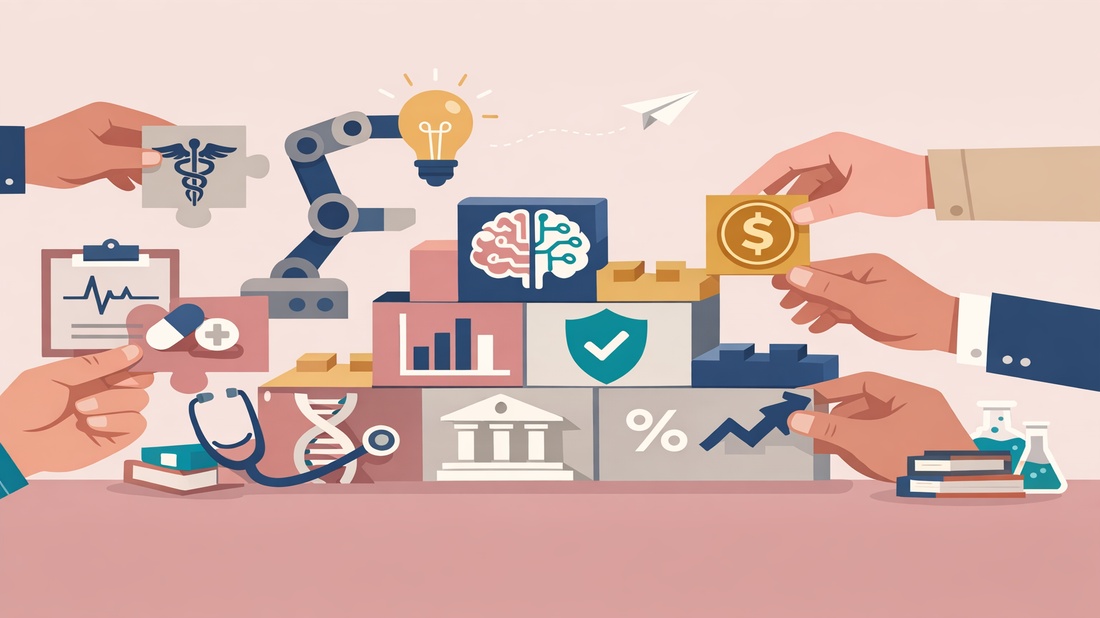
Why domain expertise matters more than raw AI skill
Most organizations now understand how to use AI at a surface level. Teams can prompt large language models, automate reports, and prototype workflows with impressive speed. Yet when these same systems are asked to support a clinician’s diagnosis or flag a financial compliance risk, that confidence often evaporates. The gap isn’t computational power. It’s domain understanding.
AI systems trained without deep contextual grounding tend to behave like bright interns: quick to respond, eager to help, and prone to subtle but serious mistakes. In healthcare and finance, subtle is dangerous. A misinterpreted lab value or a misclassified transaction doesn’t just lower efficiency; it creates legal, ethical, and human consequences that organizations cannot ignore.
This is why domain expertise has become the real differentiator in applied AI. As research surveys of AI adoption across industries have shown, value comes not from generic models but from systems shaped by sector-specific data, rules, and professional judgment. The future of AI training isn’t about teaching everyone to code neural networks. It’s about teaching AI to think more like the people who already know the work best.
What “training” means in domain-specific AI
When people hear “AI training,” they often imagine technical fine-tuning or massive datasets labeled by anonymous contractors. That’s part of the picture, but it’s incomplete. Domain-specific AI training sits at the intersection of technology, education, and organizational learning.
At its core, this kind of training teaches AI systems the language, constraints, and priorities of a profession. It also teaches human teams how to work with those systems responsibly. A hospital implementing clinical decision support, for example, must train models on medical data and train clinicians to interpret probabilistic outputs without overreliance. Both sides matter equally.
Effective domain training usually blends several approaches that reinforce each other over time:
- Curated datasets drawn from real operational contexts rather than generic corpora.
- Ongoing feedback from practitioners who understand edge cases and failure modes.
- Structured learning programs that help employees integrate AI into daily workflows instead of treating it as a separate tool.
- Governance frameworks that define what AI is allowed to decide, recommend, or simply observe.
The point is not perfection. It’s alignment. When AI systems and human experts share a common frame of reference, errors become easier to spot and outcomes become easier to trust.
Training AI for healthcare: precision, trust, and restraint
Healthcare exposes the limits of generic AI faster than almost any other field. Medical data is messy, incomplete, and deeply contextual. Symptoms overlap. Guidelines change. Ethical stakes are always present, even when the task seems routine.
Domain-specific training in healthcare starts with respecting this complexity. Models must learn clinical language, but also the difference between correlation and causation in patient outcomes. They must handle uncertainty without pretending confidence. That’s why many medical AI researchers have moved slowly, as noted by experts tracking the pace of medical model development ahead of 2026, prioritizing validation over speed.
Equally important is who trains the models. Increasingly, organizations rely on pre-verified clinicians and medical researchers to annotate data, evaluate outputs, and challenge assumptions. Platforms that connect AI teams with vetted domain experts, such as those described in recent research on expert-in-the-loop evaluation, have become essential for building systems clinicians will actually use.
Training also extends to healthcare staff themselves. Doctors, nurses, and administrators need to understand how AI reaches its conclusions, where it performs well, and where it fails. Without that shared literacy, even the best-trained model risks rejection or misuse.
Training AI for finance: judgment under pressure
Finance operates under a different kind of intensity. Decisions are fast, regulatory scrutiny is constant, and mistakes are measured in both money and reputation. Here, domain expertise isn’t optional; it’s embedded in law.
AI training in finance focuses heavily on constraint awareness. Models must understand regulatory boundaries, audit requirements, and risk thresholds that vary by jurisdiction. A system trained only on historical transaction data may spot patterns, but without compliance context it cannot judge whether an action is permissible.
This is where domain-trained AI shows its value. When models are developed alongside compliance officers, risk analysts, and auditors, they learn not just what tends to happen, but what is allowed to happen. That distinction changes everything. It reduces false positives, improves explainability, and makes regulators more willing to engage constructively.
Financial institutions are also investing heavily in upskilling their workforce, aligning with broader labor trends identified by organizations like the McKinsey Global Institute in its analysis of AI and the future of work. Analysts are being trained to question AI outputs intelligently, not accept them blindly. That cultural shift matters as much as any algorithmic improvement.
Beyond healthcare and finance: domain AI everywhere
Once you understand the pattern, it’s hard not to see it everywhere. Agriculture uses AI trained on soil science and climate data, not generic imagery alone. Manufacturing relies on models that understand equipment physics and maintenance cycles. Marketing teams increasingly demand systems that grasp brand voice, regulatory claims, and customer psychology rather than just engagement metrics.
What ties these examples together is the move away from one-size-fits-all AI. Domain expertise acts as a lens that filters raw computational capability into something practical and safe. Without it, AI remains impressive but fragile.
Emerging fields like quantum AI education, explored through recent partnerships between advanced computing companies and training providers, highlight this same truth. Even as the underlying technology evolves, the need for contextual grounding remains constant. Advanced tools don’t remove the need for expertise; they amplify it.
Building a domain-focused AI training program
Organizations often ask where to start. The answer is rarely “buy a better model.” More often, it’s about designing a training ecosystem that respects both human and machine learning curves.
A strong program usually begins with a clear map of where AI decisions intersect with domain risk. From there, teams can identify which roles need deeper AI literacy and which AI systems need deeper domain input. Providers like Leveragai focus on this intersection, helping enterprises design training that reflects real operational complexity rather than abstract skill checklists.
Several principles tend to separate effective programs from expensive experiments:
- Training is continuous, not a one-off workshop or deployment phase.
- Domain experts are involved early and compensated for their time and judgment.
- Success metrics include trust, adoption, and error reduction, not just speed or cost savings.
- Governance and ethics are treated as design constraints, not afterthoughts.
The organizations that get this right don’t talk about “AI projects.” They talk about evolving capabilities.
The human side of domain AI training
One of the quiet shifts happening inside companies is a redefinition of expertise itself. Data scientists are learning to speak the language of clinicians and accountants. Domain experts are learning to ask better questions of models. This mutual education is where lasting value emerges.
Universities and professional programs have begun to reflect this blend, as seen in the expanding career paths for data science graduates across healthcare, finance, and policy. The most effective professionals are no longer defined by a single discipline but by their ability to translate between them.
AI doesn’t replace domain expertise. It puts it under a brighter light. When models fail, they expose gaps in understanding that were always there. When they succeed, they do so because human knowledge has been carefully encoded, reviewed, and respected.
Conclusion
Building domain expertise with AI is less about technological ambition and more about professional humility. It requires admitting that intelligence, whether human or artificial, only works well within context. Healthcare, finance, and every other high-stakes field demand systems that understand their rules, values, and risks from the inside.
As AI continues to spread across industries, the organizations that invest in domain-specific training will move with confidence rather than caution. They will deploy tools that support judgment instead of undermining it. And they will discover that the most powerful AI systems are not the ones that know everything, but the ones that know their place.
Ready to create your own course?
Join thousands of professionals creating interactive courses in minutes with AI. No credit card required.
Start Building for Free →