

How Real-Time AI Feedback Accelerates Learning (And Why Waiting for Grades Doesn't Work)
April 14, 2026 | Leveragai | min read
Waiting for grades breaks the learning loop. Real-time AI feedback closes it—while the thinking is still fresh.
The latency problem with grades
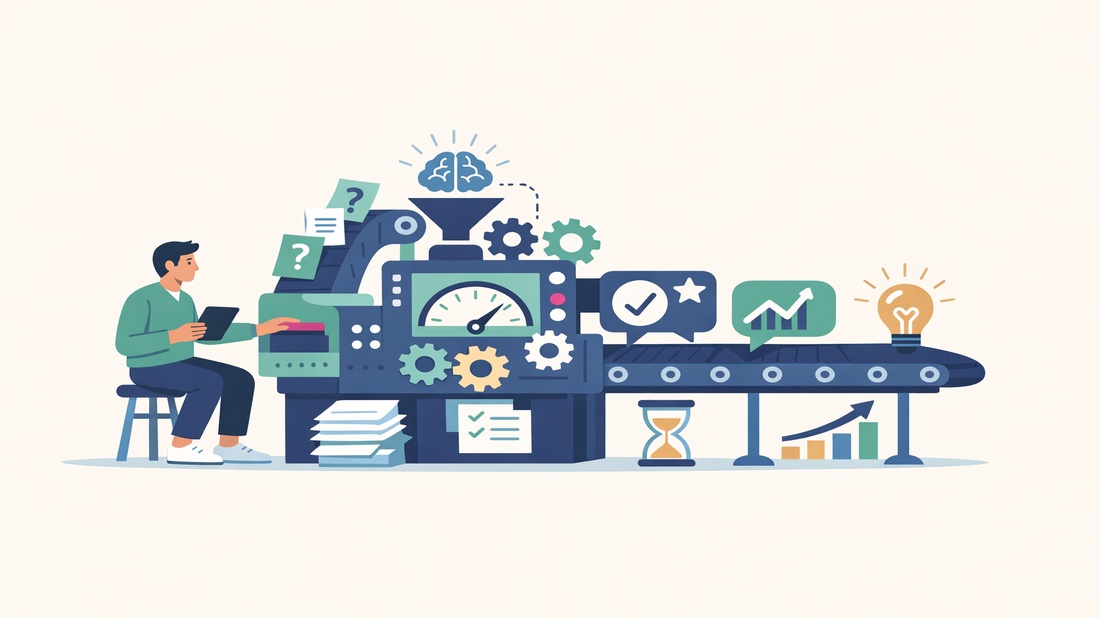
Most of us learned in systems built around delay. You submit an assignment, wait a week or two, and then get a score with a few comments in the margin. By the time that feedback arrives, you’ve already moved on—mentally and emotionally. The work is cold. The context is gone. Whatever lesson the grade was supposed to teach lands softly, if it lands at all.
That delay isn’t just inconvenient. It actively interferes with learning. Cognitive science has been clear on this for decades: feedback works best when it arrives close to the moment of effort. When the gap stretches, the brain struggles to connect cause and effect. You remember the grade, not the reasoning error. You remember how it felt, not what to change next time.
Grades were designed for administrative efficiency, not learning speed. They batch evaluation to save time for instructors and institutions. The cost is paid by learners, who are asked to reconstruct their thinking weeks later and somehow improve. Most don’t. They skim the comments, check the score, and file it away as history.
Why real-time feedback changes how brains learn
Learning is a loop. You try something, observe the result, adjust, and try again. When that loop runs quickly, improvement feels almost inevitable. When it runs slowly, motivation drains away. This is why musicians practice with immediate auditory feedback and athletes train with instant physical cues. Education has been the outlier.
Real-time feedback works because it aligns with how memory and attention actually function. When feedback arrives while the problem is still active in working memory, the brain can tag the correction to the exact decision that caused the error. That tagging is what makes the next attempt better. Without it, learners are left guessing which part of their thinking was wrong.
There’s also a psychological effect that’s easy to underestimate. Immediate feedback reduces anxiety. You’re not left wondering whether you’re off track. You can course-correct in seconds instead of stewing for days. That sense of forward motion matters, especially for complex skills where progress is uneven and confidence is fragile.
What AI can do in the moment
Artificial intelligence is uniquely suited to close the feedback gap because it doesn’t need to wait. It can observe a learner’s input, compare it to patterns it understands, and respond instantly. Not with a final verdict, but with guidance that keeps the loop moving.
In practice, real-time AI feedback tends to fall into a few overlapping roles that reinforce each other:
- It flags errors as they happen, pointing out misconceptions before they harden into habits.
- It suggests next steps or alternative approaches while the learner is still engaged.
- It adapts the level of challenge based on performance, easing up or pushing further in response to what it sees.
- It explains “why,” not just “what,” offering short, contextual reasoning instead of generic comments.
What matters is not that the AI is always right. It won’t be. What matters is that it is present. The learner isn’t alone with their confusion, and they don’t have to wait for permission to improve.
From classrooms to code editors
You can see the impact of real-time feedback most clearly in domains that already rely on it. Software development is a good example. Modern code editors underline mistakes as you type, suggest improvements, and warn you when something will break. Developers don’t write an entire program and then wait a week to see if it compiles. They learn through constant, low-stakes correction.
Recent research backs this up. A randomized controlled trial discussed among experienced developers on Reddit found that while perceptions of speed varied, real-time AI assistance changed how developers approached problems, tightening feedback loops and reducing rework. Even when productivity gains were modest, learning effects were persistent because the guidance arrived during the act of problem-solving, not after the fact.
The same pattern shows up in writing, language learning, and even healthcare training, where AI systems can adapt in real time to changing inputs and guide decisions as they unfold. In each case, the value isn’t automation for its own sake. It’s the compression of time between action and insight.
Where human judgment still matters
None of this makes human teachers obsolete. In fact, it makes their role clearer. AI is good at immediate, tactical feedback. Humans are better at strategic guidance, motivation, and ethical judgment. The problem with traditional grading is not that it involves humans, but that it asks them to do everything at once, long after the moment has passed.
Real-time AI feedback handles the mechanical parts of correction, freeing instructors to focus on patterns over time. Instead of marking the same mistake on thirty papers, a teacher can look at where students are consistently getting stuck and address that directly. The feedback becomes a conversation rather than a verdict.
Jeremy Daly makes a similar point when writing about product management in the AI era: real-time feedback has always been the goal; AI simply collapses the distance. The human role doesn’t shrink. It sharpens. Teaching becomes less about policing errors and more about shaping understanding.
Designing for continuous feedback
The hardest shift isn’t technical. It’s cultural. Many learning systems are still built around checkpoints instead of flow. To take advantage of real-time AI feedback, you have to design experiences that expect iteration, not perfection on the first try.
Platforms like Leveragai are built around this assumption. Instead of positioning AI as a grader at the end, they embed it as a guide throughout the learning process. Feedback arrives while learners are thinking, experimenting, and revising, which keeps momentum high and frustration low.
When continuous feedback is designed well, a few principles tend to show up consistently:
- Feedback is specific and actionable, tied to the learner’s immediate context.
- Corrections are framed as prompts to explore, not judgments to accept.
- Progress is visible, so learners can see improvement over time rather than fixating on single scores.
- Human oversight remains, using AI insights to inform coaching rather than replace it.
These principles don’t require futuristic technology. They require a shift away from waiting.
Conclusion
Waiting for grades made sense when feedback was expensive and slow. It doesn’t make sense anymore. The longer we delay insight, the more learning decays into performance theater—work done for a score rather than understanding.
Real-time AI feedback accelerates learning because it respects the rhythm of thought. It meets learners where they are, when they are there, and helps them adjust before confusion turns into habit. The result isn’t just faster improvement. It’s deeper engagement and a clearer sense of progress.
The future of learning won’t be defined by smarter exams. It will be defined by shorter distances between effort and understanding.
Ready to create your own course?
Join thousands of professionals creating interactive courses in minutes with AI. No credit card required.
Start Building for Free →