

Upskilling While Burnt Out: A Realistic Guide for People Running on Empty
May 20, 2026 | Leveragai | min read
Upskilling doesn’t have to mean pushing harder. This guide shows how to learn and grow when you’re already running on empty.
When “Just Push Through” Stops Working
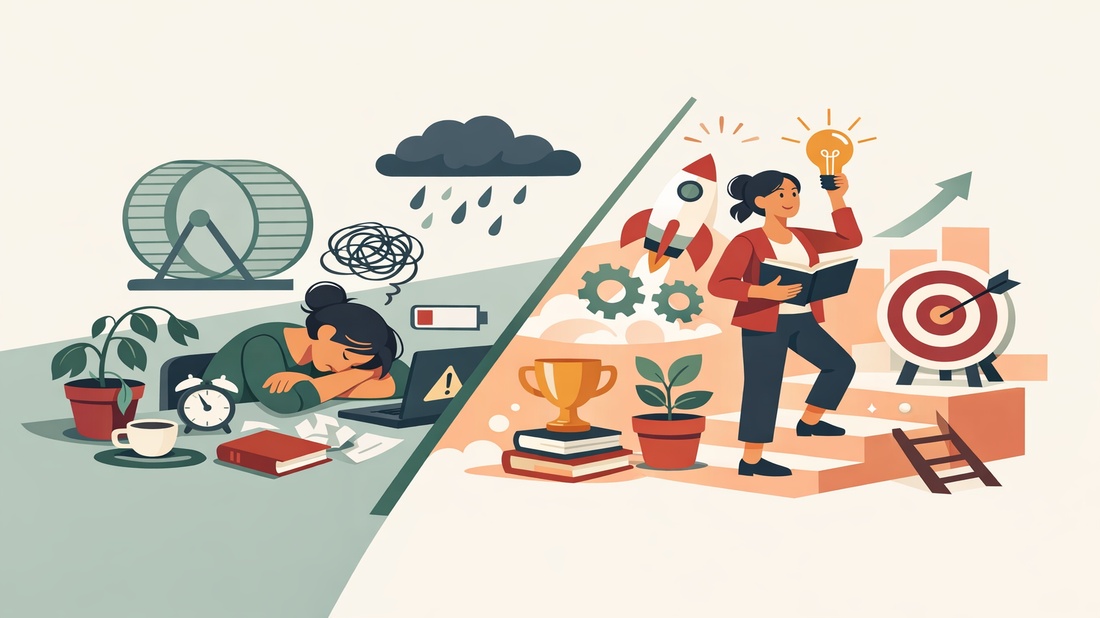
Burnout doesn’t arrive with fireworks. It creeps in quietly, first as a dull tiredness, then as cynicism, brain fog, and a strange emotional flatness that makes even good news feel irrelevant. By the time people admit they’re burnt out, they’ve usually tried pushing through for months. That’s when advice about “staying motivated” or “optimizing your mornings” starts to feel insulting.
The tricky part is that burnout often collides with pressure to upskill. Jobs evolve, industries shift, and standing still can feel dangerous. You might know you need new skills to stay relevant or to escape the role that burned you out in the first place. But the idea of learning anything new feels impossible when even answering email drains you.
According to HelpGuide’s overview of burnout symptoms and recovery, burnout isn’t just stress; it’s a state of emotional and mental depletion where motivation disappears and hope narrows to a pinprick. That matters, because most learning advice assumes you have spare cognitive and emotional capacity. Burnt-out people don’t. Any realistic guide to upskilling has to start there.
Burnout Changes How Learning Feels
When you’re burnt out, your brain behaves differently. Concentration is fragile. Memory feels unreliable. Even small decisions can feel heavy. This isn’t a personal failing; it’s your nervous system stuck in survival mode. Emily and Amelia Nagoski, in their work on stress and burnout discussed with Brené Brown, describe burnout as stress that never gets completed. The body never receives the signal that it’s safe to rest.
That’s why traditional learning structures can backfire. Long courses, aggressive timelines, and performance metrics mimic the same pressure patterns that caused the burnout. Instead of curiosity, they trigger avoidance. Instead of momentum, they produce guilt.
This is also why people sometimes assume they’re “bad at learning now” or that they’ve lost their edge. In reality, they’re trying to learn under conditions that actively suppress the cognitive processes learning requires. Upskilling while burnt out isn’t about discipline; it’s about designing around limited capacity.
Redefining What Upskilling Means Right Now
One of the most damaging assumptions is that upskilling must look ambitious. New career paths. Big certifications. Dozens of hours a month. When you’re already exhausted, that framing turns growth into another source of threat.
A more realistic definition is quieter. Upskilling becomes about staying connected to your field, reducing future anxiety, and slowly rebuilding confidence. It’s less about transformation and more about continuity. That shift alone can lower the emotional cost enough to make learning possible again.
At this stage, useful upskilling often falls into a few broad categories that don’t demand sustained intensity:
- Light exposure to trends or tools in your field, just enough to keep context.
- Skill maintenance, reinforcing things you already know rather than adding complexity.
- Low-stakes experimentation, where the outcome doesn’t matter.
- Learning that directly reduces daily friction at work.
Each of these keeps you professionally “warm” without requiring the cognitive load of mastery. The point isn’t to impress anyone. It’s to prevent the additional stress of feeling left behind. Once energy returns, ambition can return with it.
Designing Learning for a Low-Energy Brain
When energy is scarce, structure matters more than motivation. The goal is to remove as many points of friction as possible so learning doesn’t compete with survival tasks like work, rest, and basic functioning.
Short sessions work better than planned marathons. Ten minutes that actually happen beats an hour that lives only in your calendar. Asynchronous formats matter too, because burnout often comes with unpredictable energy dips. If a learning resource punishes inconsistency, it will eventually be abandoned.
This is where modern learning platforms can help if used carefully. At Leveragai, for example, we often see learners arrive not because they’re ambitious, but because they’re tired and scared of stagnation. The most successful ones don’t try to “power through” courses. They pick narrow, immediately relevant modules and treat them as optional enrichment rather than obligations. That psychological reframing is doing as much work as the content itself.
The environment matters too. Learning in the same place you work can blur boundaries and trigger stress responses. Even small changes, like a different chair or time of day, can signal safety to your nervous system. Burnout recovery literature consistently emphasizes the importance of completing the stress cycle, not just adding more inputs. Learning should feel like a gentle stretch, not another weight.
Letting Go of Linear Progress
One of the hardest adjustments for burnt-out high performers is accepting non-linear progress. Some weeks you’ll learn a lot. Others, nothing at all. This inconsistency can trigger shame, especially if you’re used to tracking metrics and streaks.
But learning during burnout doesn’t follow clean arcs. It looks more like scattered dots that only connect later. You might read an article, forget it, then months later realize it subtly changed how you think. That still counts. Cognitive integration often happens during rest, not effort.
Online communities are full of stories that reflect this pattern. In productivity forums and burnout recovery threads, people often describe stepping away from structured goals entirely, then slowly re-engaging with low-pressure learning once their anxiety decreased. The common thread isn’t hustle; it’s permission to pause.
If you measure success during this phase, measure it differently. Did the learning reduce fear? Did it make a task slightly easier? Did it remind you that you’re still capable of understanding new things? Those are meaningful outcomes, even if they don’t fit neatly on a résumé.
Protecting Recovery While You Upskill
There’s a legitimate risk in upskilling while burnt out: you can prolong or deepen the burnout if learning becomes another demand. That’s why recovery has to stay the priority, even if career pressure is real.
Boundaries are essential. Learning time should be capped, not open-ended. If you notice irritability, dread, or physical tension increasing, that’s data, not weakness. It means the load is too high. Adjusting downward is not quitting; it’s calibrating.
It also helps to be honest about why you’re learning. Fear-based motivations, like avoiding layoffs or proving worth, are powerful but expensive. Curiosity-based motivations are cheaper, but harder to access during burnout. When fear is the only fuel available, learning should be minimal and practical, focused on immediate stability rather than long-term dreams.
If burnout intersects with neurodivergence, chronic illness, or caregiving responsibilities, this becomes even more important. Autistic burnout, for example, involves profound exhaustion and loss of function that can’t be solved with better time management. In those cases, learning may need to stop entirely for a period, and that pause can be part of a responsible long-term strategy.
Choosing What Not to Learn
A realistic guide to upskilling while burnt out has to include restraint. Every “yes” to learning something new is a “no” to rest, relationships, or recovery. That tradeoff deserves conscious attention.
This often means ignoring loud advice about what you “should” learn. Trend-driven skill lists can amplify anxiety without offering clarity. Instead, focus on skills that either directly support your current role or clearly enable a specific next step. Everything else is noise.
It’s also okay to let skills decay temporarily. Expertise isn’t fragile in the way burnout makes it feel. Most professionals regain lost sharpness faster than they expect once energy returns. Panicking about skill atrophy usually causes more harm than the atrophy itself.
Conclusion
Upskilling while burnt out isn’t about ambition. It’s about survival with dignity. It asks for humility, patience, and a willingness to learn in ways that don’t look impressive from the outside.
If you’re running on empty, the most productive thing you can do may be to redefine productivity itself. Learn less. Learn slower. Learn in ways that make life feel slightly more manageable, not heavier. Skills will still be there when your energy comes back. Your health might not be if you ignore it now.
Growth doesn’t disappear during burnout. It just goes underground for a while.
Ready to create your own course?
Join thousands of professionals creating interactive courses in minutes with AI. No credit card required.
Start Building for Free →