

Upskilling That Pays for Itself — How AI Courses Cut Training Costs in Half
June 03, 2026 | Leveragai | min read
AI upskilling isn’t a nice-to-have anymore—it’s a cost decision. The right AI courses can cut training spend in half while making teams more productive.
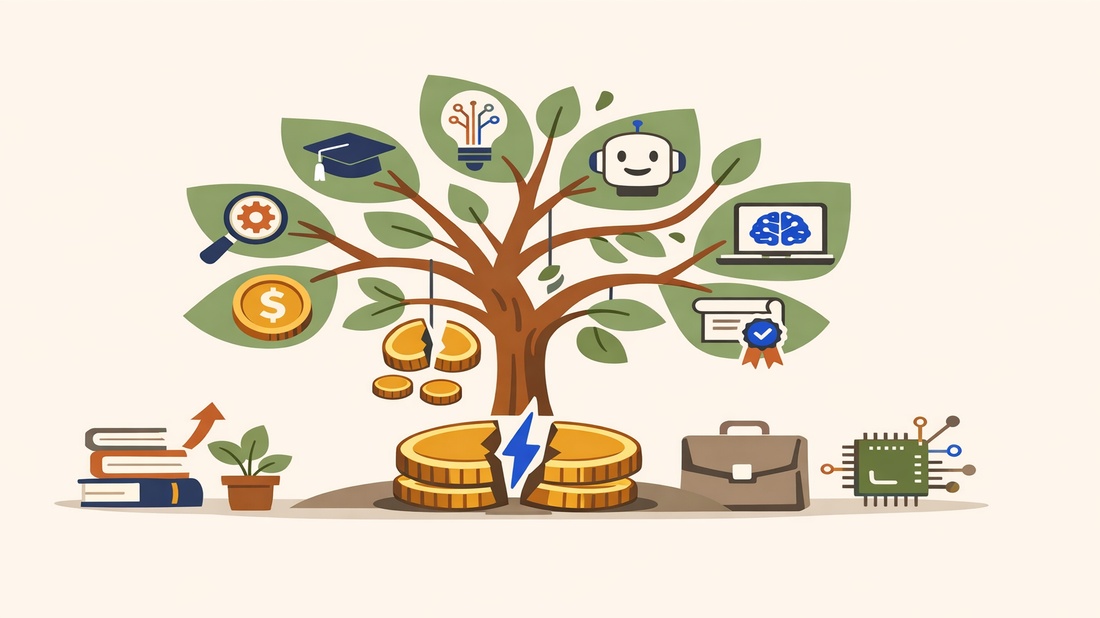
Why training costs ballooned in the first place
For years, corporate training followed a familiar pattern. Long workshops. External consultants. Generic content stretched across days to justify the invoice. The result was predictable: high spend, uneven engagement, and skills that faded before they were ever applied. Training budgets grew not because learning was effective, but because it was inefficient.
Digital learning was supposed to fix this, yet many organizations simply moved the same old material into video libraries and learning management systems. Completion rates looked fine on paper, but productivity rarely moved. When budgets tightened, training was often the first line item questioned, because leaders struggled to connect it to real outcomes.
AI changes this equation in a quiet but decisive way. Not by making training flashier, but by making it narrower, faster, and closer to the work people actually do. When done well, AI upskilling cuts out wasted hours, reduces reliance on outside vendors, and shortens the time between learning and measurable impact.
The economics of AI upskilling look different
One reason AI courses pay for themselves is simple math. The underlying cost of AI tooling and infrastructure has dropped sharply over the past few years, a trend widely discussed in technical circles and echoed in research communities like those on Reddit’s computer science forums. As training costs decline, the return window narrows. Skills that once took months and large teams to teach can now be introduced in weeks with smaller cohorts.
But the bigger shift is structural. AI learning is modular by nature. Instead of sending employees through broad, role-agnostic programs, companies can focus on specific workflows: writing better client reports, automating routine analysis, or speeding up internal research. That focus trims both time and spend.
According to McKinsey’s 2025 report on AI in the workplace, nearly every company is investing in AI, yet only a fraction feel mature in how it’s used. That gap isn’t about ambition. It’s about capability. Organizations that train people to apply AI directly to their day-to-day work see returns faster, because productivity gains show up in hours saved and errors avoided, not abstract future potential.
How AI courses reduce direct training expenses
Traditional training racks up costs in obvious ways. Travel, venues, printed materials, and instructor fees add up quickly. AI courses, particularly those delivered online and tied to real tools, sidestep much of this overhead. Sessions can be shorter, cohorts smaller, and updates continuous rather than episodic.
There’s also a compounding effect. Once a team learns how to use AI systems responsibly and effectively, they become internal multipliers. They answer questions, share prompts, and adapt workflows without waiting for the next formal program. Over time, this reduces dependence on external trainers and consultants.
The most effective AI upskilling programs tend to share a few structural traits that make the savings tangible:
- They focus on applied skills rather than theory, so learners return to work producing value immediately.
- They use real company data and scenarios, cutting down on abstraction and rework.
- They are updated frequently, avoiding the cost of rebuilding entire courses when tools change.
- They encourage peer learning, which spreads knowledge without additional budget.
Each of these elements trims a different cost center. Together, they explain how organizations routinely see training spend drop by 30 to 50 percent within a year of adopting targeted AI courses.
Time saved is money saved
Training costs aren’t just about invoices. They’re also about opportunity cost. When employees spend days away from their core responsibilities, projects slow down and deadlines slip. AI courses, when designed properly, respect this reality. They fit into the rhythm of work rather than interrupt it.
Short, focused sessions mean people learn one capability at a time, apply it, and move on. That cadence matters. Research on workforce reskilling for Industry 4.0 highlights that learning retention improves when education is closely tied to immediate application. Less repetition is needed, and fewer refresher sessions are required later.
This is where many organizations see the “pays for itself” moment. A marketing analyst who saves two hours a week using AI-assisted research tools has effectively covered the cost of their training within a month. Multiply that across a department, and the numbers stop being theoretical. They show up in project velocity, backlog reduction, and faster decision-making.
Avoiding the hidden costs of poorly planned AI training
Not all AI courses deliver these savings. Some actually add cost by creating confusion, compliance risk, or shadow IT. When employees experiment without guidance, they may misuse tools, expose sensitive data, or build brittle workflows that need to be redone later.
This is why structure matters as much as content. Courses need to address not only how to use AI, but when not to. Clear boundaries around data handling, model limitations, and ethical use prevent expensive clean-up work down the line. Microsoft’s recent writing on community-first AI infrastructure underscores how responsible adoption reduces long-term risk and expense.
A well-designed program also sets expectations. AI won’t replace entire roles overnight, a point echoed in ongoing discussions about job impact across tech communities. Instead, it reshapes tasks. Training that frames AI as a collaborator rather than a magic fix tends to produce steadier, more sustainable gains.
Where Leveragai fits into the equation
At Leveragai, the focus is on practical AI courses that align directly with business outcomes. The goal isn’t to teach everything about AI. It’s to teach the right things, in the right order, for the roles that need them now. That restraint is part of how costs stay down.
Leveragai’s programs are built around real workflows and real tools, with content that evolves as the technology does. This reduces the need for frequent retraining cycles and helps teams stay current without starting from scratch. For organizations comparing the cost of ongoing external consulting versus internal capability building, the difference is stark.
By concentrating on applied skills and measurable outcomes, Leveragai helps companies reach the point where AI training stops being a recurring expense and starts behaving like an investment with a clear payback period.
Measuring whether your AI training is actually paying off
Cutting costs is only meaningful if performance holds steady or improves. The good news is that AI upskilling lends itself to concrete measurement. Instead of tracking attendance or completion, organizations can look at operational metrics that already exist.
Project turnaround times, error rates, customer response speed, and internal support tickets often shift within weeks of effective training. These indicators tell a clearer story than satisfaction surveys ever could. They also help justify continued investment to finance and leadership teams who want numbers, not narratives.
It’s worth revisiting these metrics regularly. AI tools change, and so do workflows. Ongoing measurement ensures training stays aligned with reality, preventing the slow creep of inefficiency that plagued earlier learning models.
Conclusion
AI upskilling doesn’t have to be a budget drain. When courses are focused, applied, and thoughtfully designed, they reduce both direct training expenses and the hidden costs of lost time and misaligned effort. That’s how they end up paying for themselves.
The organizations seeing the biggest gains aren’t chasing hype. They’re making deliberate choices about what to teach, who to teach it to, and how quickly those skills are put to work. In doing so, they’ve found that cutting training costs in half isn’t a bold promise. It’s a byproduct of doing the work differently.
Ready to create your own course?
Join thousands of professionals creating interactive courses in minutes with AI. No credit card required.
Start Building for Free →