

Upskilling Doesn't Have to Suck: How AI Turns Boring Training into Addictive Learning
May 17, 2026 | Leveragai | min read
Most training fails because it’s built for compliance, not curiosity. AI changes that by making learning responsive, personal, and hard to put down.
Why Traditional Upskilling Feels So Miserable
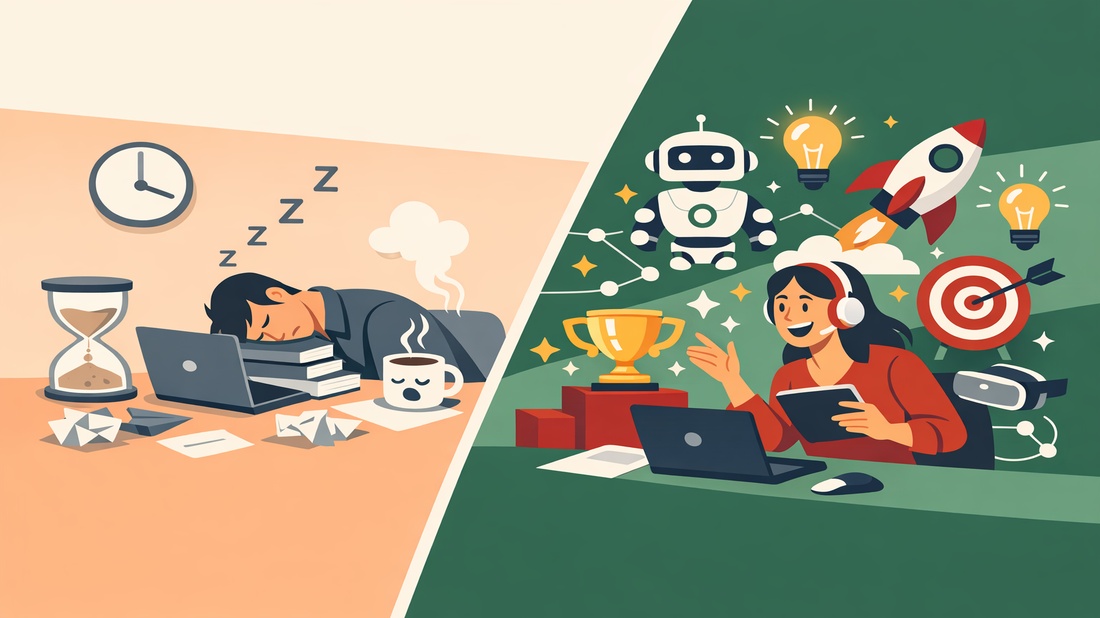
Most training programs aren’t designed to teach. They’re designed to prove that teaching happened. Slides are checked off, videos are watched at double speed, quizzes are passed with the bare minimum. A certificate appears at the end, and everyone pretends something meaningful changed.
Learners feel this disconnect immediately. They’re asked to absorb abstract material divorced from their actual work, on someone else’s schedule, at a pace that’s either insultingly slow or panic-inducing. The result isn’t curiosity or mastery. It’s quiet resentment and a browser tab that’s never quite in focus.
This is why so many people in tech talk openly about being exhausted by “constant learning.” Scroll through communities like Reddit or Hacker News and you’ll see the same refrain repeated in different keys: learning used to be fun, now it feels like survival. AI didn’t invent that fatigue, but it’s exposing how brittle the old approach really was.
The uncomfortable truth is that most corporate upskilling was boring long before AI showed up. We just didn’t have a better alternative, so we learned to tolerate it.
What AI Actually Changes About Learning
AI’s real contribution to learning isn’t automation. It’s responsiveness. For the first time at scale, training can react to the learner instead of forcing the learner to adapt to the training.
That sounds abstract until you experience it. Instead of being locked into a fixed curriculum, you’re met where you are. The system notices what you already understand, where you hesitate, what you avoid, and how you tend to solve problems. The content shifts accordingly, often without you realizing it’s happening.
This is the same feedback loop that makes good games hard to put down. You’re constantly operating at the edge of your ability, not drowning in confusion and not coasting on autopilot. When learning lives in that narrow band, it stops feeling like effort and starts feeling like momentum.
This is why some developers, despite their very real anxieties about AI replacing parts of their work, also admit that programming can feel playful again when paired with the right tools. The technology doesn’t remove thinking. It removes friction. That distinction matters.
From Passive Content to Active Participation
Traditional training treats learners like containers. Information is poured in, and success is measured by how much doesn’t spill out immediately. AI flips that relationship by making learning something you do, not something you sit through.
Instead of watching a generic video about a concept, you’re asked to apply it in a context that looks suspiciously like your actual job. You try, you fail in small ways, and the system responds with guidance that’s specific to what you just did wrong. Not a canned explanation. A targeted nudge.
Over time, this creates a subtle but powerful shift. Learners stop asking, “Will this be on the test?” and start asking, “What happens if I try this?” That curiosity is the engine of real skill development, and it’s something static content has always struggled to spark.
Platforms like Leveragai lean into this by designing learning environments that feel more like conversations than courses. The AI isn’t there to impress you with its intelligence. It’s there to keep you engaged long enough to actually get better at something that matters.
Personalization That Goes Beyond Your Job Title
Most “personalized” training today amounts to little more than role-based filtering. Developers see developer content. Managers see management content. Everyone else is left somewhere in between. AI allows for a much finer grain of personalization, and that’s where things get interesting.
Two people with the same job title often have wildly different strengths, gaps, and ambitions. One might need deep technical reinforcement. Another might struggle more with communication or decision-making under pressure. Treating them the same isn’t fair or effective.
AI can track these nuances over time. It notices patterns in how someone learns, not just what they get wrong. Do they rush? Do they overthink? Do they disengage when examples feel irrelevant? Those signals shape what comes next, creating a learning path that feels uncannily well-timed.
This kind of personalization also helps address a quieter problem: confidence. When learners aren’t constantly confronted with material that’s either beneath them or far beyond them, they’re more willing to stick with the process. Progress becomes visible, and motivation follows.
Making Learning Feel Safe Again
One of the least discussed benefits of AI-driven learning is psychological safety. Traditional training is public in all the wrong ways. Quizzes are graded. Scores are tracked. Mistakes feel permanent. For adults who already worry about keeping up, that pressure can shut learning down completely.
AI creates space for private failure. You can try something, get it wrong, and try again without an audience. The feedback is immediate and specific, but it isn’t judgmental. There’s no raised eyebrow, no implication that you should already know this.
This matters even more in fields where AI itself is a source of anxiety. Many professionals aren’t afraid of learning new skills; they’re afraid of discovering they’re already behind. A system that meets them with curiosity instead of evaluation lowers that barrier dramatically.
Ironically, this is how learning worked before it was formalized and scaled. We experimented. We asked dumb questions. We learned by doing. AI doesn’t invent that dynamic. It restores it.
The Thin Line Between Addictive and Exploitative
Calling learning “addictive” makes some people uneasy, and that’s fair. The same techniques that keep learners engaged can be misused to keep them compliant or endlessly busy without real payoff.
The difference lies in intent and design. Addictive learning, at its best, is self-reinforcing because it delivers genuine progress. You keep going because you can feel yourself improving, not because you’re chasing arbitrary rewards or streaks.
Responsible AI platforms are explicit about this. They optimize for skill transfer, not time spent. They surface mastery, not just activity. They make it easy to stop when you’ve achieved what you came for.
This is also where transparency matters. Learners should understand how the system adapts to them and what data it uses to do so. Trust isn’t a nice-to-have in learning. It’s foundational.
What This Means for Teams and Organizations
When learning stops being a chore, everything around it changes. Managers don’t have to nag. Employees don’t have to pretend. Upskilling becomes something people opt into rather than endure.
Organizations that embrace this shift often notice secondary effects. Knowledge spreads more organically. People experiment more at work because learning has trained them to see mistakes as information, not failure. Conversations about growth become more concrete because progress is visible and shared.
This is why AI-powered learning isn’t just an L&D concern. It’s a cultural lever. Used well, it signals that the organization values curiosity, autonomy, and real competence over box-ticking.
Leveragai’s approach reflects this philosophy by treating learning as an ongoing dialogue rather than a one-off event. The goal isn’t to flood people with content. It’s to help them build confidence and capability in ways that stick.
Conclusion
Upskilling doesn’t have to feel like homework assigned by someone who’s never done your job. It doesn’t have to drain energy or quietly reinforce the fear that you’re falling behind. Those outcomes aren’t inevitable. They’re artifacts of outdated design.
AI offers a different path, not because it’s flashy, but because it’s attentive. It listens, responds, and adapts. It turns learning into something active, personal, and, yes, sometimes hard to put down.
When training respects how people actually learn, motivation stops being the problem. Momentum takes over. And for the first time in a long while, getting better at your work can feel less like survival and more like growth.
Ready to create your own course?
Join thousands of professionals creating interactive courses in minutes with AI. No credit card required.
Start Building for Free →