

Upskilling by Unlearning — Why Forgetting Old Skills Is Harder Than Building New Ones
May 20, 2026 | Leveragai | min read
We celebrate learning new skills, but quietly struggle to let old ones go. This piece explains why unlearning is harder—and how to do it on purpose.
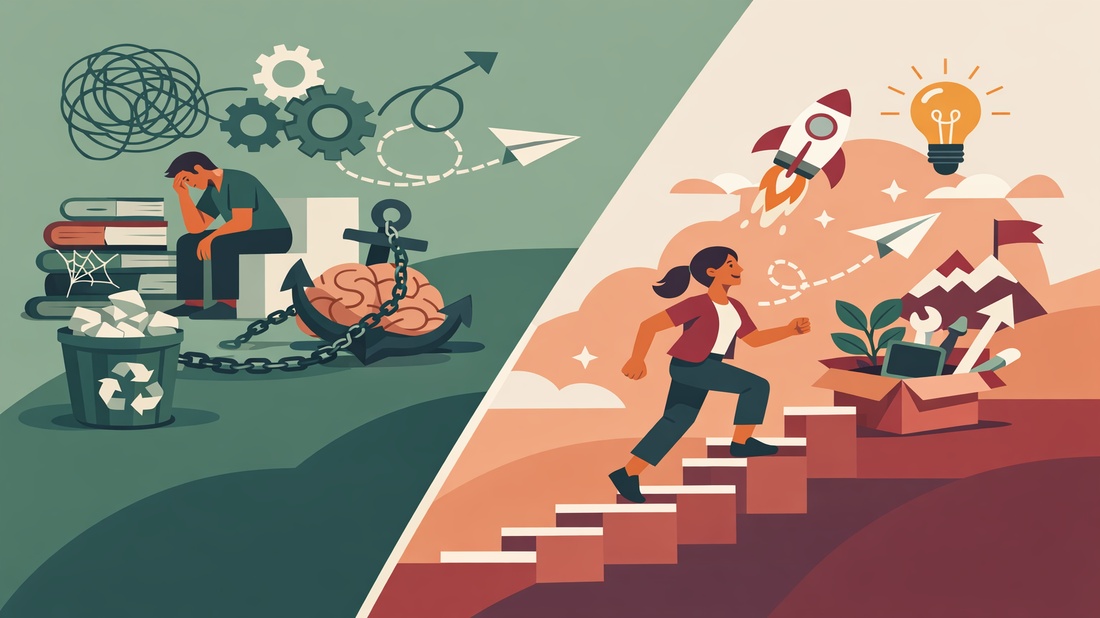
The hidden half of upskilling
Most conversations about upskilling focus on acquisition. New tools. New frameworks. New credentials. The assumption is simple: if you add enough knowledge on top of what you already know, progress will follow. Yet anyone who has tried to shift careers, adopt a new leadership style, or move from manual processes to automation knows the uncomfortable truth. The hard part isn’t learning what’s new. It’s stopping yourself from doing what used to work.
Unlearning rarely gets the spotlight because it feels negative, even wasteful. Why discard experience you worked so hard to build? But in practice, upskilling without unlearning is like installing modern software on legacy hardware. The system runs, but slowly, unpredictably, and with frequent crashes. Old habits quietly override new intentions, especially under pressure.
This is why so many reskilling initiatives stall after early enthusiasm. People attend training, pass assessments, and then revert. Not because they didn’t understand the new material, but because their brains are still optimized for an earlier version of the job. Upskilling demands subtraction as much as addition.
Why the brain resists letting go
At a neurological level, forgetting is not the same as deleting a file. Skills are encoded through reinforced neural pathways built over time and repetition. The more often a pathway is used, the more efficient it becomes. From the brain’s perspective, abandoning a well-worn route in favor of a new, uncertain one is irrational.
This is why long-practiced skills resurface even after periods of disuse. A discussion on Reddit about why we “forget” practiced abilities captures this intuitively: the brain doesn’t erase old connections so much as deprioritize them when new ones appear, and under stress it often defaults back to the strongest network it has built. Those old circuits are simply faster to fire.
There’s also an energy cost to change. New skills require conscious attention, which is metabolically expensive. Old skills run on autopilot. When cognitive load increases—tight deadlines, public scrutiny, high stakes—the brain conserves energy by falling back on familiar patterns. This is why someone trained in modern collaborative management may suddenly become directive and controlling during a crisis. The behavior isn’t a moral failure. It’s a neural shortcut.
Habits don’t disappear, they wait
Unlearning is often framed as breaking bad habits, but that framing is misleading. Habits don’t vanish when replaced. They become dormant. Cognitive psychologist Paul Baxter, writing about performance under pressure, explains that old habits are never fully overwritten; they’re inhibited by new ones. When inhibition weakens, the old habit returns, often with surprising force.
This explains a common frustration in professional development. Someone practices a new technique successfully in low-stakes settings, only to “mess up” when it matters most. The issue isn’t insufficient practice. It’s insufficient stress testing. The new habit hasn’t yet proven itself more reliable than the old one when the system is strained.
The implication is sobering. You cannot assume that because a skill works in training, it will survive real-world complexity. Unlearning requires practicing the new behavior until it becomes the path of least resistance, even when tired, rushed, or challenged. Until then, the old habit is simply waiting its turn.
Identity is the real sticking point
Beyond neurons and habits lies something even harder to shift: identity. Skills are rarely neutral. They become part of how we see ourselves and how others see us. “I’m the analytical one.” “I’m good with people, not systems.” “I built my career on this approach.” When a skill is entangled with identity, unlearning it can feel like self-erasure.
This is one reason senior professionals often struggle more with reskilling than early-career employees. The cost of being wrong feels higher. Letting go of an established way of working can feel like admitting that past success was accidental or obsolete. That emotional friction slows learning far more than lack of ability ever could.
A thoughtful LinkedIn post on why humans struggle with unlearning captures this tension well. The author reflects on helping someone tone down an expressive writing style and asks a deceptively simple question: does unlearning even happen? In practice, what happens is reauthoring identity. You’re not becoming someone else. You’re allowing a different version of yourself to take the lead.
Organizations accidentally train people to resist change
While unlearning is deeply personal, organizations often make it harder without realizing it. Many companies reward consistency over adaptability. They promote people for mastering a specific playbook, then expect those same people to abandon it overnight when strategy shifts.
Training programs don’t help when they treat learning as a one-way transfer of information. Slide decks and certifications add knowledge, but they rarely create space to surface and challenge outdated assumptions. Worse, performance metrics often continue to reward old behaviors. People do what they’re measured on, not what the latest workshop suggests.
This is where modern learning design matters. At Leveragai, for example, upskilling programs are built around deliberate unlearning loops—moments where learners are asked to identify which behaviors must be retired, not just which ones should be adopted. Progress accelerates when letting go is made explicit, safe, and measurable, rather than implied and ignored.
Practical strategies for unlearning on purpose
Unlearning sounds abstract until you treat it as a skill in its own right. It requires intention, feedback, and repetition, just like learning something new. After years of observing what actually works in professional settings, a few patterns consistently stand out:
- Name the behavior you’re retiring. Vague goals like “be more strategic” don’t compete well with specific old habits. “Stop jumping into solution mode in the first five minutes of meetings” does.
- Create friction for the old habit. If the default is too easy, it will win. This might mean changing tools, restructuring meetings, or adding a pause ritual that interrupts automatic responses.
- Practice under mild stress. Don’t wait for a crisis. Simulate pressure so the new behavior learns to survive it.
- Get external mirrors. Self-assessment is unreliable when identity is involved. Coaches, peers, or structured feedback systems can spot regressions you’ll rationalize away.
- Reward the act of letting go. Progress isn’t just successful execution of the new skill; it’s noticing and interrupting the old one, even if imperfectly.
Each of these works because it respects how the brain actually changes. They don’t demand erasure. They build stronger alternatives and weaken the old pathways through disuse and interruption.
The quiet courage of forgetting
We tend to celebrate visible growth. New titles. New tools. New capabilities. Unlearning is quieter and often invisible. From the outside, it can look like hesitation or even regression. From the inside, it feels like standing on unstable ground without the comfort of muscle memory.
Yet this discomfort is a sign of real change. When old instincts no longer fire automatically and new ones haven’t fully taken over, you’re in the narrow space where adaptation happens. Avoiding that space keeps you competent but static. Staying in it, patiently and repeatedly, is how careers stay relevant.
Upskilling by unlearning is not about rejecting the past. It’s about honoring it without being trapped by it. The skills that got you here did their job. Thank them. Then, when the work demands something different, have the courage to set them down and build again—lighter, sharper, and better suited to what comes next.
Conclusion
Learning adds. Unlearning transforms. The difference matters. In a world where roles, tools, and expectations shift faster than ever, the ability to let go may be the most durable skill of all. Those who master it don’t just keep up. They stay free to grow.
Ready to create your own course?
Join thousands of professionals creating interactive courses in minutes with AI. No credit card required.
Start Building for Free →