

The Upskilling Graveyard: 7 Once-Hot Skills That AI Made Worthless Overnight
May 20, 2026 | Leveragai | min read
Some skills didn’t fade—they fell off a cliff. Here’s what the upskilling graveyard tells us about surviving the AI era.
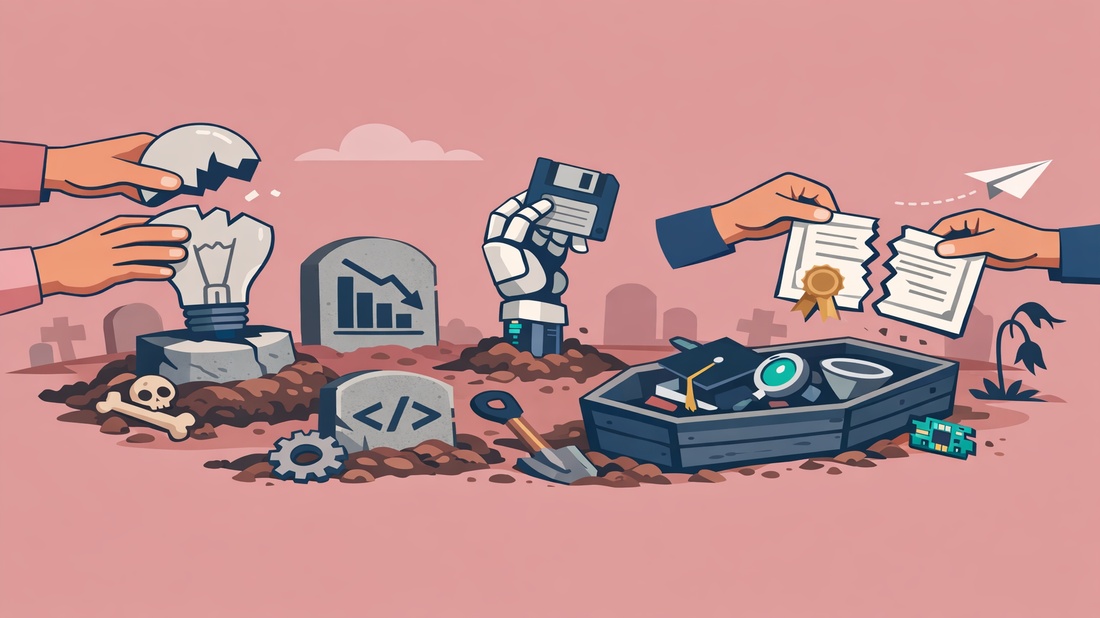
The uncomfortable truth about “future-proof” skills
Not long ago, the loudest advice in career circles was simple: keep upskilling and you’ll be safe. Learn the tools everyone wants. Stack certifications. Stay employable. It sounded sensible, even responsible. The problem is that advice assumed skills age like milk—slowly, predictably, with enough warning to step aside before the smell becomes unbearable.
AI broke that assumption. Some skills didn’t decay over years; they collapsed in months. People woke up to discover that what they’d spent nights and weekends mastering had been quietly absorbed into a model update. No announcement. No severance package. Just fewer job listings and a sinking feeling.
This isn’t a doom piece. It’s a reckoning. The skills in this graveyard weren’t stupid bets at the time—they were smart, rational responses to the market. Which is exactly why they’re worth studying now, before we repeat the same mistake with the next shiny thing.
1. SEO content writing as a standalone role
There was a period when knowing how to write “SEO-friendly” articles was a golden ticket. You learned keyword density, H2 hygiene, and how to stretch 800 words out of a vague topic without annoying Google too much. Agencies hired in bulk. Freelancers built entire businesses around it.
Then large language models learned to do it passably in seconds. Not brilliantly, not always accurately, but well enough that the economics snapped. When a first draft costs near-zero and arrives instantly, the market for commodity SEO writing doesn’t gently contract—it implodes.
What survived wasn’t the mechanical part of the skill. It was the judgment layered on top. Editorial strategy, original reporting, voice, and domain expertise still matter. But “I write SEO blog posts” stopped being a role and became a feature buried inside other jobs. Many writers didn’t lose their talent; they lost the narrow framing that made it valuable.
2. Manual data cleaning and spreadsheet wrangling
For years, being “good with Excel” was a quiet superpower. If you could clean a messy CSV, build pivot tables, and fix broken formulas, teams depended on you. Data analysts cut their teeth on exactly this kind of work.
AI-assisted tools didn’t just speed this up—they removed the need for human hands entirely in many cases. Natural language queries replaced nested formulas. Automated pipelines learned to detect anomalies and normalize inputs without a human staring at rows of numbers.
The irony is that data literacy is more important than ever. But the skill of manually wrangling data, as a job in itself, has largely vanished. The value moved upstream to asking the right questions and downstream to interpreting results in context. People who stayed anchored to the middle found themselves stranded.
3. Tier-one customer support scripting
If you ever worked in or managed a call center, you know how much effort went into scripting. Every response was tested, approved, and drilled into muscle memory. Following the script wasn’t laziness; it was compliance and efficiency.
AI chat and voice agents didn’t outperform humans at empathy, but they didn’t need to. They were good enough at resolving routine issues, and they never got tired or called in sick. Overnight, the bottom layer of support work disappeared or shrank to a shadow of its former size.
What remains is escalation handling, relationship repair, and complex problem-solving. That’s harder work, and there’s less of it. The old path—start in tier one, work your way up—has narrowed dramatically. For many, the ladder itself is gone.
4. Basic graphic design production
There was a time when knowing your way around Photoshop or Illustrator guaranteed steady work. Resize this banner. Adjust that color. Swap out the headline and export six versions. It wasn’t glamorous, but it paid the bills.
Generative design tools changed the math. Non-designers can now produce “good enough” visuals on demand, and they can iterate without waiting in a queue. The production layer of design—the repetitive, execution-heavy part—was the first to go.
Senior designers are still very much in demand, but their value comes from taste, systems thinking, and brand coherence. The skill that died wasn’t design itself; it was being a human rendering engine. If your value was speed alone, AI was faster.
5. Entry-level coding for routine tasks
“Learn to code” was the advice of the 2010s, and it wasn’t wrong. Even basic scripting could open doors, automate grunt work, and signal technical competence. Bootcamps flourished on the promise that a few months of training could change your life.
AI coding assistants didn’t make programmers obsolete. They did, however, erase the premium on writing simple, well-understood code from scratch. CRUD apps, basic scripts, and boilerplate-heavy work can now be generated, debugged, and explained by a model in real time.
The market adjusted brutally. Junior roles shrank. Expectations jumped. Knowing syntax stopped being impressive; understanding systems, trade-offs, and constraints became the real differentiator. The entry ramp got steeper, not flatter.
6. Social media scheduling and caption writing
Once upon a time, brands hired people whose primary job was to plan posts, write captions, and schedule content across platforms. Consistency was king, and volume mattered.
AI tools absorbed that entire workflow. Captions, hashtags, timing suggestions, even image variants can now be produced and scheduled automatically. What used to take a team now takes a prompt.
The surviving roles look very different. They focus on narrative, community dynamics, and cultural timing—things models still struggle with. But the idea that scheduling and captioning alone constitute a job has quietly slipped into the past.
7. Mock-based sales and interview training
Sales training, interview prep, and “mock calls” were once seen as essential practice. Repetition built confidence. Simulated scenarios stood in for the real thing.
AI simulations changed how people practice, but they also exposed a flaw. Perfectly scripted practice environments don’t prepare you for messy, human conversations. In sales especially, teams discovered that AI-driven mock calls could create false confidence without real-world adaptability.
As a result, the value shifted away from simulation-heavy training toward live coaching, real call analysis, and situational judgment. Practicing with a machine isn’t useless—but as a standalone skill or service, it lost credibility fast.
Why these skills died so quickly
Looking across this graveyard, a pattern emerges. These skills shared three traits: they were procedural, repeatable, and valued primarily for efficiency. AI excels at exactly that combination.
The people hit hardest weren’t lazy or short-sighted. They did what the market rewarded. The mistake was assuming that demand for a task equals long-term demand for the skill behind it. When the task can be automated cheaply, demand evaporates.
This is where many upskilling narratives go wrong. They focus on tools instead of judgment, execution instead of context. At Leveragai, this distinction comes up constantly in conversations with teams adopting AI. The organizations that struggle aren’t the ones without access to tools; they’re the ones that never redefined what humans are responsible for once the tools arrive.
What actually ages well in an AI-heavy world
If this article leaves you uneasy, that’s understandable. But the lesson isn’t “don’t learn new skills.” It’s “learn the parts that don’t compress well.”
Skills tied to decision-making, ethics, domain understanding, and cross-functional thinking age more slowly because they’re harder to abstract. They don’t disappear overnight; they morph. Managing AI systems, setting guardrails, aligning outputs with business goals, and knowing when not to automate are already becoming core competencies.
The safest bet isn’t chasing the next hot tool. It’s building the capacity to evaluate tools critically and integrate them into messy human systems. That kind of skill rarely trends on social media, but it’s the difference between riding the wave and being pulled under by it.
Conclusion
The upskilling graveyard isn’t a warning against learning—it’s a warning against learning narrowly. The skills that died weren’t foolish; they were incomplete. They optimized for execution and ignored ownership.
AI didn’t make these people irrelevant. It made the old shape of their value obsolete. The faster we internalize that distinction, the better chance we have of staying useful when the next wave hits.
Ready to create your own course?
Join thousands of professionals creating interactive courses in minutes with AI. No credit card required.
Start Building for Free →