

The 'Netflix Effect' in Upskilling: Why Binge-Learning Actually Works with AI
May 17, 2026 | Leveragai | min read
Binge-learning isn’t a lack of discipline—it’s a response to better design. With AI, the Netflix Effect is changing how adults actually build skills.
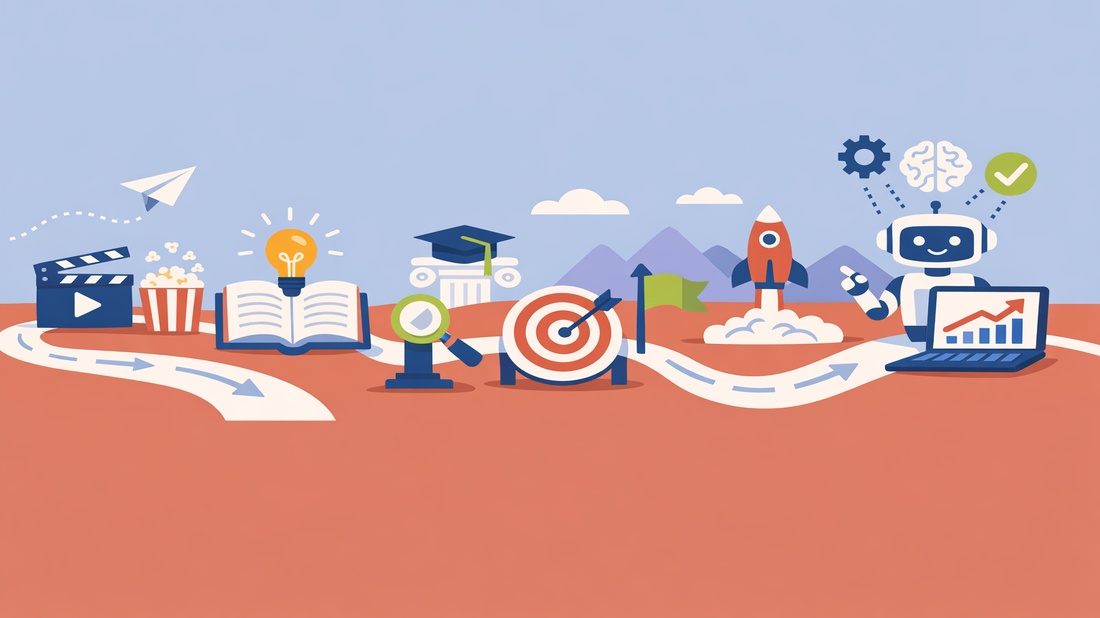
From Guilty Pleasure to Learning Pattern
For years, binge-watching carried a whiff of shame. Too many episodes, too late at night, not enough restraint. Learning, by contrast, was supposed to be disciplined and evenly paced, delivered in neat modules spaced across weeks. You studied a little, reflected a lot, and trusted that progress would accumulate.
Then AI arrived, and the contrast started to look artificial. People began learning the way they watch shows: in intense bursts, following curiosity rather than syllabi, staying up late not because they had to, but because they wanted to keep going. The same professional who can’t commit to a twelve-week course will happily spend an entire weekend mastering a new AI workflow if it feels relevant and responsive.
This isn’t a failure of willpower. It’s a signal that our older ideas about “good learning habits” were shaped by scarcity—limited teachers, static content, fixed schedules. AI removes much of that friction. When learning becomes adaptive, contextual, and immediately useful, bingeing stops being indulgent and starts being efficient.
What the Netflix Effect Really Means
The Netflix Effect isn’t just about consuming content in large doses. It’s about how recommendation systems anticipate what you want next, reduce decision fatigue, and maintain narrative momentum. You’re never asked to stop and plan. The next episode simply appears, already tuned to your taste.
Applied to upskilling, the effect is subtle but powerful. AI-driven learning tools don’t just present information; they respond. They notice what you struggle with, what you skip, what you linger on. They adjust tone, depth, and examples in real time. That creates a sense of flow that traditional courses rarely achieve.
Michael Horn has drawn explicit parallels between Netflix-style personalization and AI-powered education, arguing that responsiveness—not content volume—is what sustains engagement over time (as explored in his writing on AI tutoring and personalization: https://michaelbhorn.substack.com/p/how-ai-can-help-educatorsand-high). When learners don’t have to constantly recalibrate their path, they stay immersed. Immersion, not moderation, is what drives progress.
Why Binge-Learning Works Better With AI
Binge-learning has always existed. Think of exam cramming, hackathons, or the obsessive deep dives people take when switching careers. What’s changed is the cost. In the past, intense learning meant confusion, gaps, and burnout. You moved faster than feedback could keep up.
AI changes that balance. It compresses feedback loops to seconds instead of days. You try something, it breaks, you ask why, and you get an answer tailored to your exact mistake. That immediacy makes sustained focus not only possible but productive.
There’s also a motivational shift. Adults don’t learn well for abstract future rewards. They learn when the payoff is visible now. AI tools surface relevance constantly—connecting a concept to your current job, your last prompt, your real dataset. That relevance keeps people in the chair longer than any reminder email ever could.
When binge-learning works, it’s usually because four conditions are met at once:
- Feedback is immediate and specific, not delayed or generic.
- Progress is visible, even if mastery isn’t complete.
- The learning path adapts instead of forcing linear completion.
- Curiosity, not compliance, drives the next step.
Taken together, these conditions explain why someone can spend six uninterrupted hours learning AI-assisted analysis and emerge energized rather than exhausted. The system is doing part of the cognitive load that used to make intensity unsustainable.
The Job Market Makes Intensity Rational
The push toward binge-learning isn’t happening in a vacuum. Many knowledge workers are watching their roles shift faster than annual training cycles can handle. Software engineers see AI writing functional code. UX researchers see hiring booms reverse into sudden contractions. The signal is noisy, but the message is clear: static skill sets age quickly.
In that environment, slow and steady doesn’t always win. What matters is how fast you can close a gap when it appears. Binge-learning is a rational response to volatility. When a new tool or expectation emerges, people need competence now, not after a semester.
Importantly, this doesn’t mean AI replaces professionals. Even in debates about whether AI will displace programmers, the consensus among practitioners is that engineering is more than code output; it’s judgment, architecture, and context. What changes is the baseline. Upskilling becomes less about adding credentials and more about staying fluent.
Platforms like Leveragai are built around this reality. Instead of assuming learners want a long, linear curriculum, they support focused, high-intensity learning paths that adapt as goals shift. That’s not indulgence. It’s alignment with how work actually changes.
Designing for Momentum, Not Completion
Traditional learning design obsesses over completion rates. Did you finish the course? Did you pass the assessment? Those metrics made sense when learning was episodic and externally mandated.
Binge-learning flips the question. Momentum matters more than completion. If someone learns exactly what they need in three days and stops, that’s not a failure. It’s success with a clean exit. AI makes those exits possible because it doesn’t rely on pre-packaged arcs. It responds to readiness.
This also reframes burnout. Intensity isn’t the problem; misalignment is. People burn out when effort doesn’t translate into progress. When AI keeps effort and reward tightly coupled, sustained focus feels surprisingly natural.
That’s why the best AI learning experiences feel less like courses and more like conversations. You don’t “finish” them so much as outgrow one question and move on to the next. The binge ends not with guilt, but with a sense of closure.
What This Means for Learners and Teams
For individual learners, the Netflix Effect is permission to trust your instincts. If you feel like going deep for a short period, that’s not a character flaw. It may be the most efficient way to learn right now. The discipline shifts from pacing yourself to choosing good problems.
For organizations, the implication is more uncomfortable. Annual training calendars and one-size-fits-all programs will feel increasingly out of step. Employees will expect learning to meet them where they are, at the speed their work demands. AI makes that expectation reasonable.
Leveragai’s approach reflects this shift by focusing on adaptive, role-aware learning experiences rather than static content libraries. The goal isn’t to keep people enrolled; it’s to help them move through skill transitions quickly and confidently, even if that happens in intense bursts.
Conclusion
Binge-learning works with AI because it aligns with how adults actually learn when friction is removed. The Netflix Effect isn’t about distraction or excess. It’s about momentum, relevance, and responsiveness. When learning systems adapt in real time, intensity becomes an asset rather than a liability.
As AI continues to reshape work, the ability to learn deeply and quickly will matter more than perfect consistency. The future of upskilling won’t look like a syllabus. It will look like a well-timed “next episode,” offered exactly when you’re ready to keep going.
Ready to create your own course?
Join thousands of professionals creating interactive courses in minutes with AI. No credit card required.
Start Building for Free →