

Teach to Learn: How AI Helps Experts Upskill by Turning Knowledge into Courses
June 03, 2026 | Leveragai | min read
Teaching has always been one of the fastest ways to learn. AI now makes it practical for experts to turn what they know into courses—and upskill in the process.
Why teaching has always been a shortcut to mastery
Most experts can point to a moment when they truly understood something only after they had to explain it. Not to a peer who already shared their assumptions, but to someone new. Teaching forces clarity. It exposes fuzzy thinking. It turns intuition into language, and language into structure.
Cognitive science has a name for this: the protégé effect. When we expect to teach, we organize information more deeply and remember it longer. That’s why mentoring programs work and why senior professionals often say they learned more in their first year of management than in the five years before. Teaching changes how the brain prioritizes knowledge.
What’s new is not the idea, but the feasibility. Until recently, turning expertise into something teachable meant time away from work, instructional design skills, and a tolerance for blank-page paralysis. AI has changed that equation. It reduces the friction between knowing something and shaping it into a course, making “teach to learn” a practical upskilling strategy rather than a noble intention.
The modern upskilling problem for experts
Upskilling is usually framed as something juniors do. Take a course. Earn a badge. Move on. For experienced professionals, the reality is messier. They already know a lot, but much of that knowledge is tacit—built from years of pattern recognition rather than formal frameworks.
This creates a paradox. Experts need to keep learning, especially as AI tools reshape workflows, yet traditional training often feels either too basic or oddly disconnected from real work. IBM’s own research on AI upskilling emphasizes learning in the flow of work rather than isolated training blocks, because that’s where expertise actually evolves. Reading about a model or tool is one thing; integrating it into how you think is another.
Teaching offers a way out of this bind. When experts translate their lived experience into lessons, they surface assumptions they didn’t know they had. They notice where their knowledge is outdated. They see where AI can augment their thinking and where it can’t. The act of course creation becomes a diagnostic tool for their own skill gaps.
How AI turns knowledge into teachable structure
The hardest part of teaching is rarely the content. It’s the structure. What comes first? What can be skipped? Where do examples matter more than theory? AI is particularly good at helping experts answer these questions without pretending to replace their judgment.
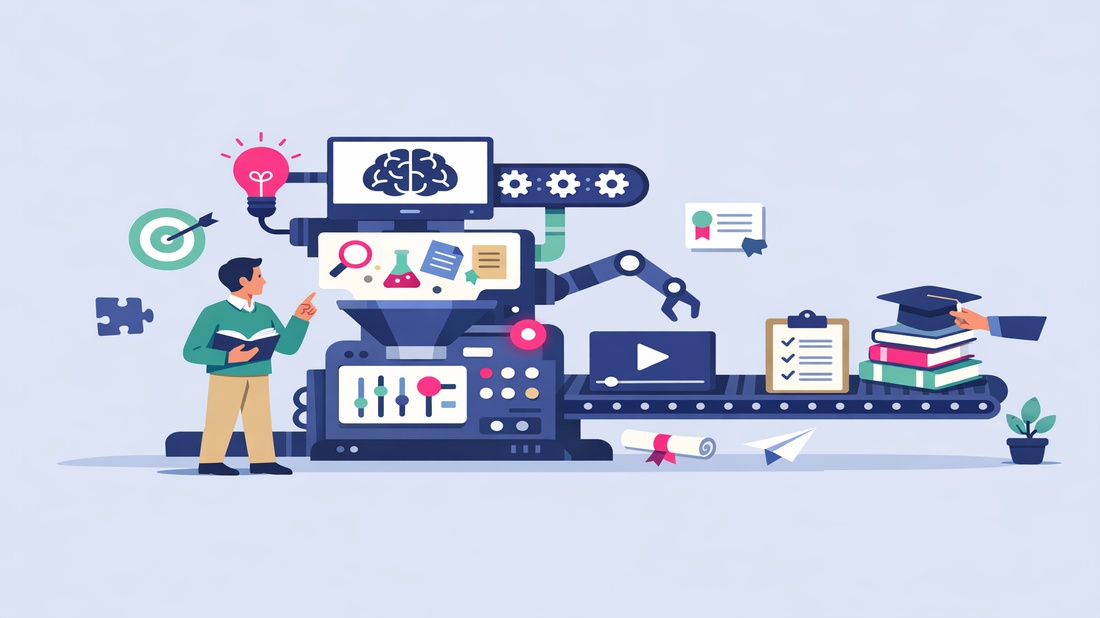
Modern AI systems can listen to raw input—voice notes, rough outlines, recorded explanations—and help organize it into coherent modules. They can suggest learning objectives based on what an expert already does intuitively. They can surface parallels to established frameworks, which helps bridge personal experience with shared language.
This doesn’t mean the AI “knows” the subject better. It means it’s good at patterning information. When used well, it becomes a thinking partner that asks, in effect, “If you were teaching this, what would someone need first?” That prompt alone can sharpen an expert’s own understanding.
Platforms like Leveragai build on this idea by focusing on course creation as a learning process for the expert, not just a content pipeline. The goal isn’t to mass-produce videos. It’s to help professionals externalize their thinking, test it against real learners, and refine it as both the subject and the expert evolve.
Learning by building: what experts gain in the process
When experts create courses with AI support, the benefits go beyond a polished curriculum. The process itself changes how they think about their work.
First, there’s forced precision. Vague concepts don’t survive contact with learners. If you can’t explain why a decision matters, or when an exception applies, you probably don’t understand it as well as you thought. AI-assisted drafting accelerates this realization by quickly turning hand-wavy ideas into concrete text that can be examined and improved.
Second, there’s reflective updating. As experts review AI-generated outlines or explanations, they often spot outdated assumptions. This is especially common in fields shaped by AI tools, where workflows change faster than job titles. A study discussed among experienced developers suggests many feel significantly faster with AI assistance, but that speed gain only holds if they rethink how they work. Teaching makes that rethink unavoidable.
Third, there’s confidence with humility. Seeing your knowledge laid out exposes both depth and gaps. That’s uncomfortable, but productive. It encourages targeted upskilling rather than generic “learn AI” goals. You don’t need everything. You need what strengthens your teaching.
From static courses to living knowledge assets
Traditional courses are frozen snapshots. They reflect what someone knew at the moment of recording. AI makes it possible to treat courses as living systems instead.
When experts update a lesson, AI can help propagate that change across examples, quizzes, and summaries. When learners ask questions, those interactions can feed back into the course structure, highlighting where explanations fall short. Over time, the course becomes a map of both the subject and the expert’s evolving understanding.
This matters for upskilling because it aligns learning with reality. According to LinkedIn’s Workplace Learning Report, professionals increasingly value development that adapts to changing roles rather than static career ladders. A living course does exactly that. It grows as the work grows.
Leveragai’s approach reflects this shift by treating courses as products that can be iterated, not completed. For experts, this means their learning never really stops, but it also never starts from scratch.
Avoiding the trap of shallow AI-assisted teaching
There’s a legitimate concern that AI makes it too easy to produce content without understanding. We see this in academic settings, where some students use AI to avoid learning rather than deepen it, a tension highlighted by educators and researchers alike. The same risk exists for professionals.
The difference lies in intent and process. Teaching to learn only works if the expert stays in the loop. AI should draft, question, and reorganize—but not decide what matters. When experts review and revise AI output critically, the learning happens. When they publish without engagement, it doesn’t.
To keep teaching as a learning practice rather than a content shortcut, experts tend to focus on a few principles:
- They use AI to externalize thinking, not replace it.
- They validate explanations against real examples from their work.
- They invite feedback from learners and treat confusion as signal, not failure.
- They revisit and revise material as their own understanding changes.
Each of these behaviors keeps the expert cognitively engaged. The AI speeds things up, but the learning comes from judgment.
Teaching as a career accelerant, not a side project
There’s also a pragmatic angle. Teaching signals expertise in a way resumes rarely do. A well-constructed course shows how someone thinks, not just what they’ve done. In markets crowded with similar titles, that distinction matters.
More importantly, teaching builds optionality. An expert who can explain their work clearly is better positioned to lead, consult, or pivot into adjacent roles. As industries move deeper into AI-assisted workflows, the ability to articulate human judgment becomes more valuable, not less.
Magdalena H. Gross, a leader in AI education and learning strategy, often emphasizes translating deep human knowledge into forms others can use. That translation is itself a skill. AI lowers the barrier to practicing it, but the skill remains distinctly human.
Conclusion
Teaching has always been one of the most reliable ways to learn. What’s changed is how accessible it has become. With AI handling the heavy lifting of structure and iteration, experts can turn their knowledge into courses without stepping away from their work—or their growth.
The real value isn’t the finished course. It’s the thinking that happens along the way. When experts teach, they see their own knowledge more clearly, update it more honestly, and apply it more effectively. AI doesn’t replace that process. It makes it sustainable.
For professionals looking to upskill in a meaningful way, teaching isn’t a detour. With the right tools, including platforms like Leveragai, it’s the most direct path forward.
Ready to create your own course?
Join thousands of professionals creating interactive courses in minutes with AI. No credit card required.
Start Building for Free →