

Stop Googling 'How to Upskill' — Let AI Build You a Course in 5 Minutes Instead
May 17, 2026 | Leveragai | min read
Googling how to upskill is the slowest way to learn in 2026. AI can now design a course around you—your goals, gaps, and time—in under five minutes.
The problem isn’t motivation. It’s fragmentation.
Most people don’t fail to upskill because they’re lazy. They fail because learning has become a scavenger hunt. One tab for a blog post. Another for a YouTube tutorial. A half-finished course bookmarked somewhere you can’t quite remember. After an hour of searching, you’re tired before you’ve even started learning.
Googling “how to upskill” feels productive, but it’s a trap. What you get back is generic advice aimed at everyone and no one. Learn Python. Master data. Improve communication. Build projects. All true. None of it tailored. None of it sequenced for where you are right now.
That fragmentation has a real cost. It breaks momentum. It turns learning into a background chore instead of a focused practice. And for professionals already stretched thin, it’s often the reason upskilling quietly drops off the priority list altogether.
Why search-based learning stopped working
Search engines are incredible at answering questions. They are terrible at building paths. When you ask a human mentor how to grow, they don’t respond with ten unrelated links. They ask questions back. What do you already know? What are you trying to become? How much time do you actually have?
Google can’t do that. It doesn’t know whether you’re a product manager brushing up on analytics or a backend engineer trying to regain fundamentals after leaning too hard on AI copilots. It can’t see the gaps between what you know and what you need next.
This is why so many developers talk about feeling rusty despite consuming more content than ever. In one widely discussed Reddit thread, programmers admitted that heavy AI assistance sped up output but quietly eroded understanding. The issue wasn’t AI itself. It was learning without structure, without feedback loops, without intentional progression.
Search gives you answers. Upskilling requires a curriculum.
AI flips the model: from hunting to assembling
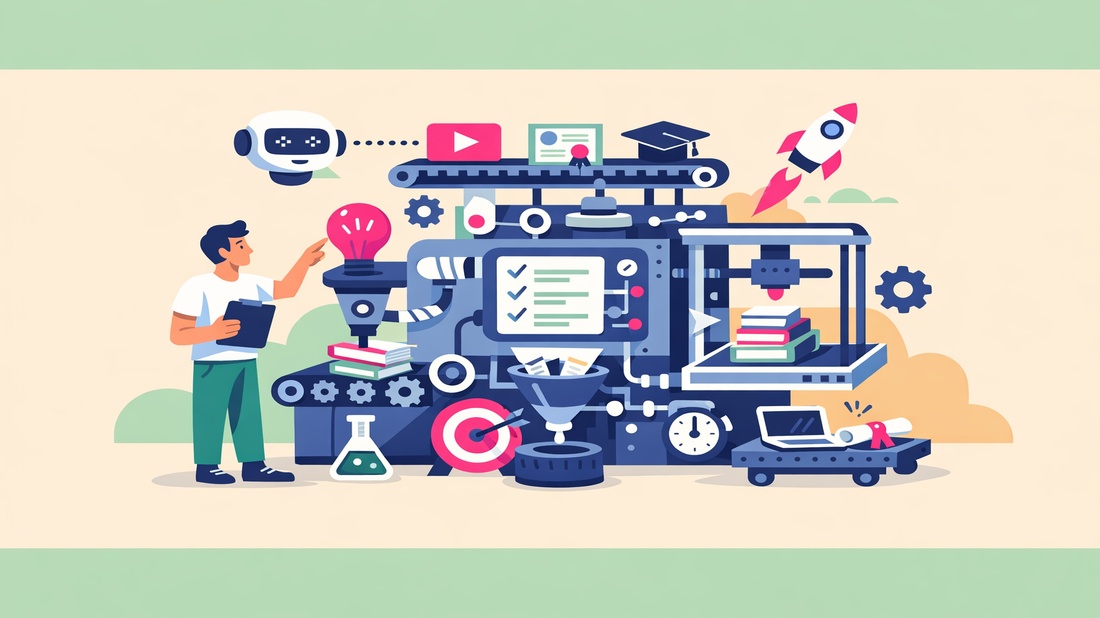
Here’s the shift that matters. Instead of you stitching together resources, AI can now assemble them for you. Not as a random playlist, but as a coherent course designed around your specific context.
Modern AI systems can ask the kinds of clarifying questions a good instructor would. They can assess your starting point, map it to an end goal, and generate a learning plan that fits your constraints. Not in weeks. In minutes.
This isn’t about dumping content on you faster. It’s about reducing the cognitive overhead that stops learning before it starts. When the path is clear, showing up becomes the only job you have left.
A well-built AI course does three things consistently. It decides what not to include. It sequences concepts so each one earns its place. And it adapts when your goals or pace change.
Those three things are exactly what search can’t do.
What a five-minute AI-built course actually looks like
There’s a misconception that an AI-generated course is just a syllabus with links. The better systems go much deeper than that. They treat learning as a living process rather than a static document.
Once you describe your goal—say, moving from generalist marketer to someone who can confidently run lifecycle experiments—the AI designs a progression. It starts where you are, not where a generic beginner might be. It assumes you have experience, blind spots, and limited time.
A solid AI-built course typically includes several core elements, woven together rather than dumped in a list:
- A clear outcome framed in practical terms, so you know what “done” actually means and can recognize progress when it happens.
- A sequenced set of modules that build on each other, avoiding both repetition and premature complexity.
- Hands-on exercises or prompts that force recall and application, not passive consumption.
- Checkpoints where the plan can adjust based on what you found easy, hard, or unexpectedly interesting.
The key difference is cohesion. Everything points in the same direction. You’re no longer guessing whether today’s tutorial matters for tomorrow’s goal.
Where Leveragai fits into this shift
This is exactly the problem Leveragai was built to solve. Instead of offering another library of courses, Leveragai acts more like a course architect. You tell it what you’re aiming for, where you’re starting, and how you prefer to learn. It handles the rest.
What makes Leveragai stand out is its focus on judgment, not just information. It doesn’t assume more content equals better learning. It prioritizes relevance, pacing, and decision-making—because those are the things that actually compound over time.
For professionals who already learn on the job, this matters. You don’t need an eight-week bootcamp. You need a tight, adaptive plan that respects what you already know and pushes you just far enough to grow. Leveragai builds that plan in minutes, then evolves it as your skills do.
The result feels less like enrolling in a course and more like having a quiet, competent mentor who never forgets your context.
The fear: “Am I outsourcing my thinking?”
This concern comes up a lot, especially among engineers and experienced operators. If AI builds the course, are you skipping the hard part? Are you becoming dependent?
It’s a fair question. But it’s also based on a misunderstanding. Outsourcing structure is not the same as outsourcing understanding. In fact, good structure makes deep thinking more likely, not less.
When you spend your energy deciding what to learn next, there’s less left for actually grappling with the material. By contrast, when the path is clear, your mind can focus on synthesis, experimentation, and reflection.
Think of it this way. No one argues that having a well-designed textbook makes students worse thinkers. The thinking happens because of the structure, not in spite of it. AI-generated courses, when done right, play the same role.
They remove friction. They don’t remove effort.
Upskilling as an ongoing system, not a side project
The most interesting professionals don’t “go learn” in discrete bursts. They treat learning as a continuous system that runs alongside their work. That system needs to be lightweight, responsive, and aligned with real-world demands.
Search-based learning can’t do that. It resets every time you open a new tab. AI-driven course building doesn’t. It remembers where you left off, what you struggled with, and what’s coming next.
This is why the question is no longer “What should I learn?” but “How should learning fit into my life?” When AI handles the architecture, learning stops feeling like an extra obligation and starts feeling like a natural extension of your work.
Five minutes to build a course isn’t the headline. The headline is what happens after. Less thrashing. More momentum. And a clear sense that the time you spend learning is actually moving you somewhere.
Conclusion
Googling “how to upskill” made sense when information was scarce. In 2026, it’s a bottleneck. The problem isn’t access to knowledge. It’s turning that knowledge into a path you can actually walk.
AI can now build that path for you in minutes. Not a generic checklist, but a course shaped around your goals, your gaps, and your reality. Tools like Leveragai show what’s possible when learning design catches up to learning ambition.
Stop searching for advice meant for everyone. Let AI build something meant for you.
Ready to create your own course?
Join thousands of professionals creating interactive courses in minutes with AI. No credit card required.
Start Building for Free →