

How to Turn Any YouTube Playlist into a Structured Upskilling Course with AI
June 03, 2026 | Leveragai | min read
YouTube is full of great learning content, but it rarely feels like a course. This guide shows how AI can turn any playlist into a structured, goal-driven upskilling program.
Why YouTube Is an Underrated Learning Goldmine
Most people treat YouTube as something to dip into rather than commit to. You watch a video, maybe two, and then the algorithm takes over. That’s fine for entertainment, but it’s a terrible way to build real skills. The irony is that some of the most practical, current, and experience-driven teaching on the internet lives inside YouTube playlists that were never designed as courses.
If you’ve spent any time learning AI, cloud, DevOps, or modern software tooling, you’ve probably felt this tension. The content is excellent, often better than paid alternatives, yet the learning experience feels scattered. There’s no clear starting point, no sense of progression, and no explicit outcome. You’re left stitching together your own curriculum in your head.
The problem isn’t the content. It’s the structure. And structure is exactly where AI shines.
The Core Problem: Playlists Aren’t Learning Paths
A YouTube playlist is a chronological artifact. Videos are ordered by upload date, not by learning dependency. That works if you’re following a creator in real time, but it breaks down when someone new arrives six months later with a specific goal in mind.
Upskilling requires more than exposure. It needs sequencing, reinforcement, and checkpoints. Without those, learners either binge content without retention or abandon the effort entirely. This is why so many people say they’ve “watched a lot of videos” but struggle to explain what they can actually do.
Communities across Reddit and LinkedIn regularly surface this frustration, especially in fast-moving fields like AI agents and MLOps, where new frameworks appear faster than most people can contextualize them. The gap isn’t access. It’s guidance.
AI can step into that gap by acting as a curriculum designer rather than another content source.
Step One: Define the Outcome Before Touching the Playlist
Before you bring AI into the loop, you need clarity on one thing: what does “done” look like? A structured course always works backward from an outcome. “Understand MLOps” is not an outcome. “Deploy, monitor, and iterate on a production ML pipeline” is.
This step sounds obvious, yet it’s where most self-directed learning quietly fails. Without an explicit target, AI will happily summarize, categorize, and rephrase content without ever shaping it into a journey.
Once the outcome is clear, AI can be prompted to treat the playlist as raw material rather than as the course itself. At this stage, you’re not asking for summaries. You’re asking for alignment. You want the model to identify which videos support the goal directly, which are optional depth, and which are distractions.
A simple prompt like “Analyze this playlist and map each video to the skills required to achieve X outcome” already changes the nature of the exercise. You move from passive consumption to intentional design.
Step Two: Use AI to Reorder and Chunk the Content
With an outcome defined, the next transformation is structural. AI is remarkably good at recognizing prerequisite relationships, even when creators didn’t explicitly design them. It can tell that monitoring comes after deployment, that feature stores make more sense once pipelines exist, and that theory-heavy videos may belong earlier or later depending on the goal.
Instead of a single long playlist, AI can reorganize the content into modules that resemble how humans actually learn. Each module should feel coherent and bounded, not like an arbitrary slice of time.
When done well, this step usually results in a small number of high-level modules, each with a clear purpose. For example, a free MLOps playlist like the one shared by Abhishek Veeramalla on LinkedIn can be reframed into stages that move from foundations to real-world implementation rather than mirroring upload order.
At this point, AI is acting less like a tutor and more like an instructional designer. That shift is subtle but important.
Step Three: Add Context, Not Just Summaries
Summaries are easy. Context is harder. A good course doesn’t just tell you what a video says; it explains why it matters right now and how it connects to what came before.
This is where AI can dramatically improve the learning experience without creating new content from scratch. By generating short pre- and post-video explanations, AI can frame each piece of content inside the broader arc of the course.
Before a video, AI can set expectations. Afterward, it can highlight what to internalize and what can safely be skimmed. Over time, this scaffolding reduces cognitive load and makes long playlists feel navigable.
To make this concrete, AI-generated context usually falls into a few distinct categories that are worth separating deliberately:
- Orientation text that explains why this video exists at this point in the course.
- Conceptual bridges that connect ideas across videos that were never meant to sit together.
- Practical framing that translates abstract explanations into “what you should be able to do now.”
- Warnings or callouts that flag outdated tools, assumptions, or ecosystem shifts.
Used sparingly, this kind of augmentation turns passive watching into active learning. Used excessively, it becomes noise. The balance matters.
Step Four: Convert Watching into Doing
The biggest weakness of most YouTube-based learning is that it stops at watching. Structured courses don’t. They force interaction, reflection, and application.
AI can help here by generating lightweight exercises that fit the content rather than overwhelming it. These don’t need to be elaborate projects. In fact, smaller prompts often work better. “Pause and sketch a deployment flow,” or “List three failure modes you’d monitor in this setup” can be enough to shift the learner’s mindset.
What makes AI particularly useful is its ability to tailor these prompts to different levels. A beginner might get a conceptual question, while an experienced practitioner gets a scenario-based challenge. The same playlist suddenly supports multiple audiences without being rewritten.
This is also where platforms like Leveragai come into play. When AI-generated exercises, explanations, and progress tracking live alongside the content, a playlist starts behaving like a real course rather than a clever reorganization.
Step Five: Build Feedback Loops with AI
Learning without feedback is guesswork. Traditional courses rely on quizzes, peer review, or instructors. Self-paced YouTube learning usually has none of that.
AI can fill this gap in a pragmatic way. By asking learners to explain concepts back in their own words, outline designs, or reason through trade-offs, AI can provide immediate, contextual feedback. It won’t replace a human mentor, but it’s far better than silence.
This feedback loop also helps surface false confidence. Many learners feel comfortable while watching but struggle when asked to articulate or apply what they’ve seen. AI makes that friction visible early, when course correction is cheap.
Over time, this turns the playlist into a dialogue rather than a broadcast.
Step Six: Keep the Course Alive as the Field Changes
One reason people hesitate to treat YouTube seriously as a learning medium is that it feels ephemeral. Videos age. Tools change. Best practices shift.
Ironically, this is where AI-enhanced courses built on YouTube content can outperform traditional curricula. Because the underlying content is modular and loosely coupled, AI can periodically reassess relevance. It can flag videos that rely on deprecated tools, suggest newer alternatives, or reorder modules as industry norms evolve.
Communities discussing how to stay current in AI often point out that static courses decay quickly. A structured layer powered by AI allows the learning path to adapt without starting from scratch every year.
This doesn’t eliminate the need for judgment, but it dramatically lowers the maintenance burden.
From Playlist to Course: A Mental Model Shift
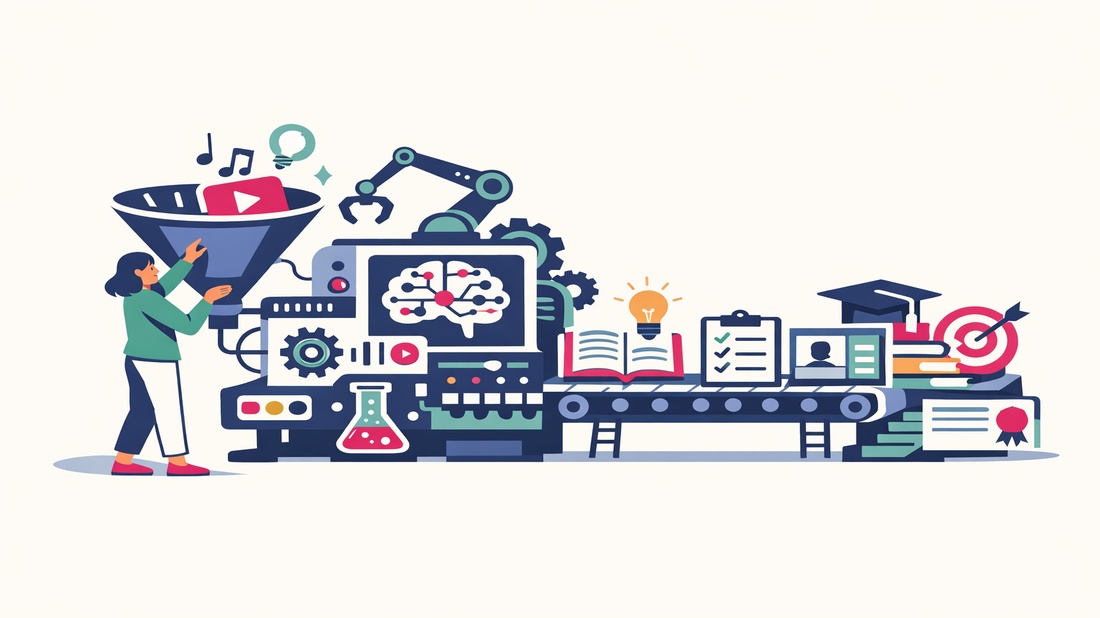
The real change here isn’t technical. It’s conceptual. You stop treating YouTube as a library and start treating it as a content substrate. The course lives above the videos, not inside them.
AI is the connective tissue that makes this possible. It interprets, organizes, contextualizes, and challenges. The videos remain what they are: explanations from people who’ve done the work. The learning experience becomes something new.
For individuals, this means faster, more reliable upskilling without waiting for the “perfect” course to appear. For teams, it means turning scattered learning resources into shared, outcome-driven programs. And for platforms like Leveragai, it’s an opportunity to rethink how courses are built in the first place—less as monolithic products, more as living systems.
Conclusion
YouTube already contains more high-quality educational material than most people could consume in a lifetime. The missing ingredient has never been access. It’s been structure.
By using AI intentionally—starting with clear outcomes, reshaping playlists into coherent modules, adding context, prompting action, and maintaining feedback—you can turn almost any playlist into a serious upskilling course. Not a replacement for formal education, but a practical alternative that meets learners where they already are.
Once you see YouTube through this lens, it’s hard to unsee it. The question stops being “Is there a course for this?” and becomes “How quickly can I turn what already exists into one?”
Ready to create your own course?
Join thousands of professionals creating interactive courses in minutes with AI. No credit card required.
Start Building for Free →