

How HR Leaders Use AI to Create Personalized Career Development Plans at Scale
March 25, 2026 | Leveragai | min read
Personalized career development no longer has to be manual or inconsistent. Here’s how HR teams are using AI to scale growth without losing the human touch.
The problem HR has been trying to solve for decades
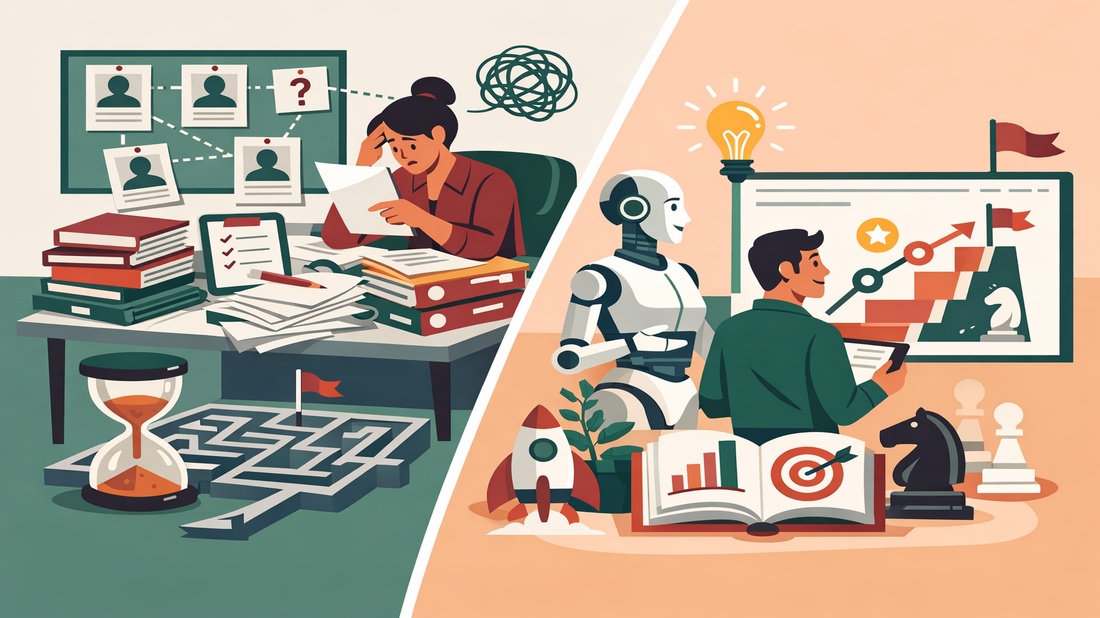
Career development has always sat in an awkward place inside organizations. Leaders talk about growth constantly, yet most employees experience it as a once-a-year conversation, quickly documented and quietly forgotten. HR teams know this gap well. They also know the reason it persists has very little to do with intent and everything to do with scale.
When you’re responsible for hundreds or tens of thousands of employees, personalization becomes brutally hard. Managers don’t have time to research career paths. HR doesn’t have the bandwidth to map skills manually. Learning teams struggle to connect courses to real progression. The result is a development system that’s generic by necessity, even when everyone agrees that people grow in different ways.
This is where AI has started to matter in a very practical sense. Not as a replacement for managers or mentors, but as infrastructure. AI gives HR leaders a way to move beyond static frameworks and create living, adaptive career plans that respond to who someone is, what they’ve done, and where they want to go.
What “personalized at scale” actually means in practice
Personalization can be a slippery word. In HR, it often gets used to describe little more than tagging a course as “recommended.” That’s not what leading teams are doing today. The newer model treats career development as a system that updates continuously, not a document created during performance review season.
At its core, AI-driven personalization connects four streams of data that used to live in separate places: role requirements, individual skills, organizational needs, and learning opportunities. When those streams talk to each other, career plans stop being hypothetical. They become actionable.
An employee doesn’t just see that they “could” become a product manager someday. They see which skills they already have, which ones are missing, how long others typically take to bridge that gap, and what experiences actually matter inside their company. Platforms from vendors like Workday have been vocal about this shift toward adaptive learning paths that respond to real-time signals rather than fixed assumptions, a direction they outline in their perspective on the future of HR management.
For HR leaders, scale doesn’t mean treating everyone the same. It means making individual guidance possible without requiring individual hand-holding.
The AI building blocks behind personalized career plans
Behind the scenes, these systems are less magical than they sound. They rely on a set of capabilities that are finally mature enough to work together reliably. What’s changed in the last few years is not the ambition, but the execution.
AI models can now infer skills from resumes, project histories, performance feedback, and even everyday work artifacts. They can compare those skills against internal role taxonomies and external labor market data. They can also adapt recommendations as employees complete training, change roles, or express new interests.
After those foundations are in place, most organizations rely on a small set of core AI functions to keep career plans current and credible:
- Skill inference and normalization, which translates messy, inconsistent job histories into a shared skills language the organization can actually use.
- Career path modeling, which analyzes real internal movement patterns instead of relying on theoretical ladders.
- Learning and experience matching, which connects skill gaps to specific courses, projects, or stretch assignments.
- Predictive readiness signals, which estimate when someone is likely to be ready for a move based on past trajectories.
What matters is not that these functions exist individually, but that they reinforce each other. A recommendation that isn’t grounded in internal data quickly loses trust. A skills model that doesn’t connect to learning never changes behavior. HR leaders who succeed here focus less on features and more on coherence.
How HR leaders are applying AI across the employee lifecycle
The most effective career development systems don’t sit off to the side. They’re embedded into moments that already matter to employees. AI becomes useful when it shows up at the right time, not when it demands extra attention.
During onboarding, some organizations are using AI to establish an initial skills baseline and suggest early development goals. IBM, for example, has described how AI-driven HR tools support professional development alongside onboarding, helping new hires see growth paths from their first weeks rather than their second year.
As employees settle into roles, AI starts to operate more quietly. It updates skill profiles based on completed work. It flags emerging interests based on learning behavior. It nudges managers when someone may be ready for a stretch assignment. This kind of ambient guidance aligns closely with what McKinsey describes in its research on AI-enabled “superagency,” where technology amplifies human judgment instead of replacing it.
For leadership development and succession planning, AI fills a long-standing gap. Harvard Business Publishing has emphasized that leadership growth fails without a plan. AI helps make those plans visible and measurable by mapping readiness across populations instead of relying on subjective nominations. HR analytics research has also shown how personalized career planning strengthens succession pipelines by surfacing non-obvious candidates early, rather than waiting until roles are vacant.
The human role doesn’t disappear—it gets sharper
One fear comes up in almost every HR discussion about AI: the loss of humanity. The irony is that poorly designed, manual systems are often what strip the humanity out of development in the first place. When managers are rushed, conversations become shallow. When HR is overloaded, guidance becomes templated.
AI changes the economics of attention. By handling the heavy lifting—data synthesis, pattern recognition, recommendation generation—it frees managers and HR partners to focus on judgment, context, and coaching. The career conversation shifts from “Here’s the framework” to “Here’s what this might mean for you.”
That shift does require discipline. HR leaders have to be explicit about what AI is allowed to decide and what remains human. Most organizations draw a clear line: AI suggests; people decide. Employees can challenge recommendations. Managers can override them. Transparency becomes part of the system’s credibility.
Tools and platforms matter here. Companies like Leveragai focus on making AI outputs interpretable rather than opaque, so HR teams can explain why a path or recommendation appears and adjust it when reality doesn’t fit the model. Trust grows when people can see the reasoning, not just the result.
Governance, bias, and the quiet risks of scale
Scaling anything in HR magnifies its flaws. Career development is no exception. If an AI model reflects biased historical data, it can quietly reinforce the very inequities HR leaders are trying to fix. That’s why governance matters just as much as capability.
Leading organizations treat career AI as a monitored system, not a set-and-forget tool. They regularly audit recommendations by gender, tenure, geography, and background. They test for feedback loops where certain groups are over-recommended for growth while others stagnate. They also involve legal and employee relations teams early, especially in regulated industries.
Transparency helps here as well. When employees understand what data is being used and how recommendations are formed, suspicion drops. Opt-in features, explanation layers, and clear escalation paths all contribute to adoption. Scale doesn’t excuse carelessness. It demands more rigor, not less.
Measuring what actually improves when career plans get personal
HR leaders are under pressure to prove that all this sophistication leads somewhere concrete. Fortunately, personalized career development lends itself to meaningful measurement, as long as metrics go beyond course completion.
Organizations that do this well track internal mobility rates, time-to-readiness for key roles, and retention among high-potential populations. They also look at softer signals, such as engagement scores tied to growth questions and manager satisfaction with development conversations.
Over time, patterns emerge. Employees with visible paths stay longer. Managers spend less time guessing and more time coaching. Succession plans become less fragile because they’re built continuously rather than refreshed annually. These outcomes are consistent with broader industry observations, including Google Cloud’s documentation of how leading companies apply generative AI to empower employees with faster insight and decision-making support.
Conclusion
Personalized career development has always been the ideal. What’s new is that it’s finally operational. AI gives HR leaders a way to honor individual ambition without sacrificing organizational clarity, and to do it for everyone, not just the most vocal or visible.
The shift isn’t about replacing human judgment. It’s about supporting it with better information, delivered at the moments that matter. When done well, AI fades into the background and career growth moves to the foreground, where it belongs.
Ready to create your own course?
Join thousands of professionals creating interactive courses in minutes with AI. No credit card required.
Start Building for Free →