

How AI-Personalized Learning Paths Cut Upskilling Time in Half
April 14, 2026 | Leveragai | min read
AI-personalized learning paths are helping organizations upskill faster by removing wasted time and generic training. This article explains how they work and why the time savings are real.
The real reason upskilling takes so long
Most upskilling programs don’t fail because the content is bad. They fail because they assume everyone needs the same journey. A data analyst with five years of SQL experience and a marketing manager moving into analytics are often handed the same course catalog, the same timelines, and the same assessments. One is bored. The other is overwhelmed. Both lose time.
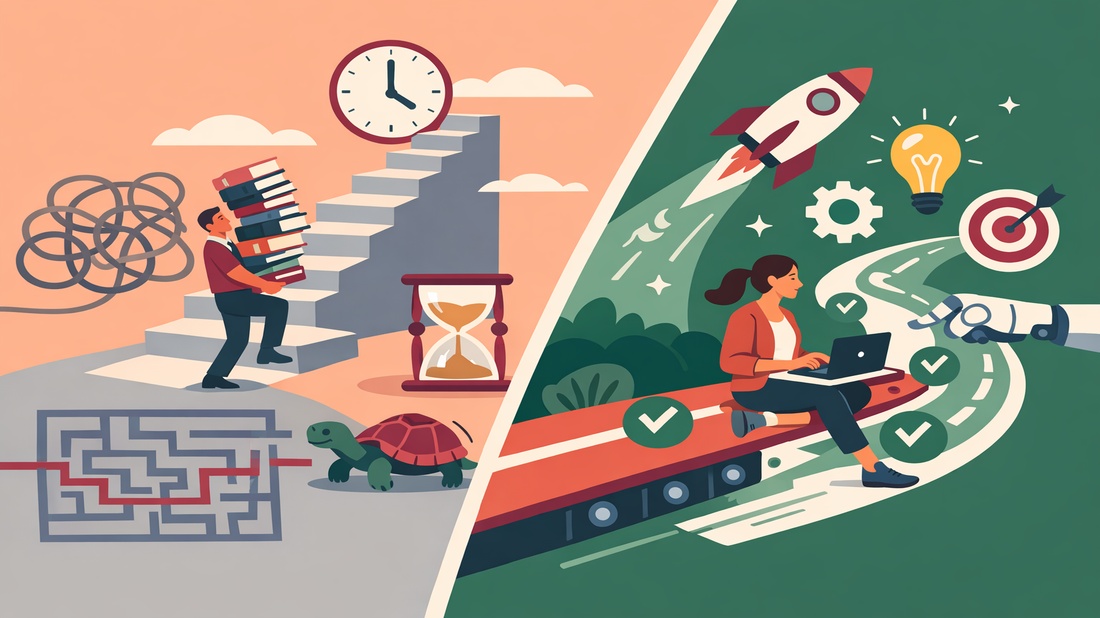
Traditional learning paths are built for administrative convenience, not human efficiency. They move linearly, reward seat time, and measure completion rather than capability. When skills requirements change quickly—as they now do—this model breaks down. Employees spend weeks relearning what they already know or wading through material they may never use. Managers see progress on paper, but productivity lags behind.
AI-personalized learning paths change the premise entirely. Instead of asking, “What course should this role complete?”, they start with a sharper question: “What does this person already know, and what do they need next to perform better?” That shift alone explains why time-to-skill drops so dramatically.
What AI-personalized learning paths actually are
The phrase “AI personalization” gets thrown around loosely, so it’s worth slowing down. This isn’t about slapping a recommendation engine onto a static LMS. True AI-personalized learning paths are adaptive systems that continuously adjust based on learner behavior, performance, and business goals.
At the core is skills intelligence. AI models analyze existing data—assessments, work outputs, role requirements, even how learners interact with content—to build a living profile of current capability. From there, the system sequences learning experiences dynamically. If someone demonstrates mastery early, the path shortens. If they struggle, it detours into targeted reinforcement.
What makes this powerful is that the path doesn’t end when a course does. It evolves. As roles change or new tools are introduced, the learning plan reshapes itself without forcing the learner back to square one. This is the difference between a curriculum and a companion.
Why time-to-skill drops by 50 percent
Cutting upskilling time in half sounds bold until you look at where the time goes in traditional programs. A surprising amount is wasted. People sit through content they don’t need, wait for scheduled sessions, or repeat entire modules just to access the one section that matters. AI removes this friction.
One documented example shared by TechClass shows an AI-personalized onboarding initiative that reduced ramp-up time by half, with new hires reaching productivity in weeks instead of months (https://www.techclass.com/resources/learning-and-development-articles/how-ai-enhances-personalization-in-corporate-training-programs). The mechanism wasn’t more content or faster delivery. It was precision.
AI-driven systems compress learning timelines by focusing effort where it counts. They do this in several interconnected ways:
- They skip known material by validating prior knowledge early, rather than assuming ignorance.
- They break learning into smaller, targeted units that map directly to skills gaps.
- They adapt pacing in real time, so learners neither stall nor rush past critical concepts.
- They surface the next best action immediately, removing decision fatigue and downtime.
The cumulative effect is dramatic. When every hour of learning addresses a real gap, progress accelerates naturally. Time-to-skill shrinks not because people work harder, but because the system stops wasting their time.
From static courses to living learning paths
Static courses made sense when roles were stable and change was incremental. That world is gone. Today’s roles evolve continuously, and learning has to keep up. AI-personalized paths are designed for this reality.
Instead of treating courses as the unit of progress, AI treats skills as the unit of value. A learning path might include a short video, a hands-on simulation, a real work task, and a quick assessment—stitched together based on relevance, not format. If the learner proves competence through performance, the system moves on.
This is where custom course creation becomes critical. Organizations with unique workflows and tools can’t rely solely on generic libraries. Providers like Leveragai design AI-driven learning paths that blend proprietary content with external resources, aligning directly to business goals rather than abstract competencies. That alignment is what keeps learning short and useful.
The result is a path that feels less like school and more like guided problem-solving. Learners aren’t “taking training.” They’re closing gaps as they encounter them.
Microlearning powered by intelligence, not guesswork
Microlearning has been around for years, but on its own it doesn’t guarantee speed. Ten-minute lessons still waste time if they’re irrelevant. AI is what turns microlearning into a serious accelerator.
AI-powered microlearning systems decide not just how long a lesson should be, but whether it should exist at all. They monitor how learners perform on the job and inject learning precisely when a gap appears. A concept that clicks immediately disappears from the path. One that causes friction resurfaces in a different format.
Research into AI-driven microlearning shows consistent reductions in overall training time, especially for onboarding and technical upskilling (https://blog.wranx.com/cut-training-time-ai-microlearning). The key is that learning becomes event-driven rather than calendar-driven. Employees learn because they need to, not because the schedule says so.
This approach respects cognitive load. Short, targeted interventions are easier to absorb, easier to apply, and easier to remember. Over time, they add up to deep capability without the drag of long-form courses.
The manager’s role in AI-personalized upskilling
One quiet benefit of AI-personalized learning paths is how they change the manager’s job. Instead of policing completion rates, managers gain visibility into actual skill development. They can see who is progressing, where bottlenecks appear, and which skills are emerging across the team.
This matters because upskilling isn’t just an HR concern. It’s an operational one. When managers understand skill readiness in real time, they can staff projects more intelligently and coach more effectively. Learning stops being a background activity and becomes part of daily work.
Modern L&D thinking emphasizes this shift. HR leaders are increasingly called to move from content delivery to capability building, using predictive analytics and personalization to stay ahead of skills gaps (https://hrexecutive.com/why-hr-leaders-must-embrace-a-new-era-of-learning-and-development/). AI-personalized paths give managers the data they need without adding administrative burden.
Avoiding the common pitfalls
AI personalization isn’t automatic success. Organizations can still get it wrong, usually by treating AI as a feature rather than a system. The most common missteps involve poor data, unclear skill definitions, or a lack of integration with real work.
Another risk is over-automation. Learners don’t want to feel managed by an algorithm. The best systems are transparent, allowing people to understand why content is recommended and how it connects to their goals. Human oversight still matters, especially for coaching and contextual judgment.
Finally, personalization must serve the business, not just the individual. Learning paths that optimize for learner preference alone can drift away from strategic priorities. That’s why platforms like Leveragai emphasize alignment with organizational skill frameworks and outcomes, ensuring speed doesn’t come at the cost of relevance.
What the next generation of learning paths looks like
Looking ahead to 2026 and beyond, AI-personalized learning paths are becoming more agentic. Instead of waiting for input, they anticipate needs. If a new tool is introduced or a regulation changes, the system proactively reshapes learning paths across affected roles.
Emerging research on agentic AI in corporate learning suggests this will further reduce wasted effort, especially in compliance-heavy environments where blanket retraining is common (https://www.hrmorning.com/articles/agentic-ai-corporate-learning-absorb/). The path becomes less reactive and more preventative.
This evolution also supports continuous reskilling. Rather than episodic training initiatives, learning becomes a steady, low-friction process woven into work. Skills decay is addressed early. New capabilities are built incrementally. Time-to-skill continues to shrink because learning never falls far behind need.
Conclusion
AI-personalized learning paths cut upskilling time in half because they respect something traditional training ignores: not everyone starts in the same place, and not everything needs to be taught. By focusing on real gaps, adapting in real time, and aligning learning tightly with work, AI removes the drag that slows development down.
The promise isn’t speed for its own sake. It’s relevance. When people learn only what they need, when they need it, progress follows naturally. For organizations serious about building skills without burning time or goodwill, AI-personalized learning paths aren’t a future idea. They’re the practical answer to a problem that’s been hiding in plain sight.
Ready to create your own course?
Join thousands of professionals creating interactive courses in minutes with AI. No credit card required.
Start Building for Free →