

Generative AI in Education: 10 Use Cases Transforming Corporate and Academic Learning
March 25, 2026 | Leveragai | min read
Generative AI is quietly changing how people learn at work and at university. These ten use cases show what’s already working—and what’s coming next.
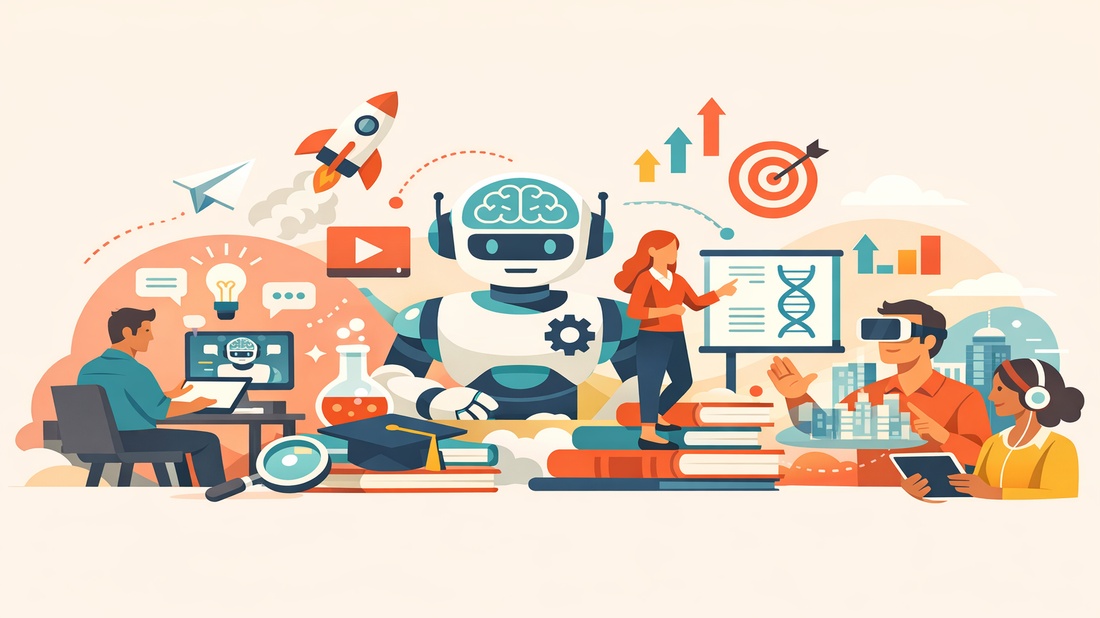
Generative AI has moved past the phase of curiosity in education. It is no longer about testing what a chatbot can do in isolation or debating whether students should be allowed to use it at all. Across universities, training departments, and professional learning teams, the conversation has become more grounded. What actually improves learning outcomes? What saves time without hollowing out thinking? What scales without flattening nuance?
The answers are emerging through real use cases. Large organizations are rolling out internal AI systems to support employee learning, while academic institutions are experimenting—sometimes cautiously—with tools that personalize instruction and support research. Reports like Stanford’s AI Index show that organizational adoption of AI continues to rise, including in education and training contexts, while industry leaders are already publishing concrete examples of how generative models support knowledge work at scale.
What follows is a clear-eyed look at ten ways generative AI is being used today in corporate and academic learning. Some are already mainstream. Others are still uneven. All of them point toward a future where learning is more responsive, more contextual, and—when implemented well—more human.
Personalized Learning Paths at Scale
One of the most immediate impacts of generative AI in education is its ability to adapt content to individual learners. Traditional learning systems rely on predefined tracks, which work fine for the average user and poorly for everyone else. Generative models change that dynamic by responding to how a learner performs, what they struggle with, and how they prefer to engage.
In corporate training, this shows up as adaptive learning paths that evolve as employees progress through material. An AI system can adjust the depth of explanations, introduce remedial content when gaps appear, or accelerate learners who already demonstrate mastery. In academic settings, similar approaches are being tested in large introductory courses where instructors simply cannot personalize instruction for hundreds of students.
The value here is not novelty. It is attention. When learning feels responsive rather than generic, people stick with it longer and retain more. The challenge, of course, is designing these systems so they support learning rather than quietly narrowing it.
AI-Powered Tutoring and Study Support
AI tutors are no longer confined to demo videos. They are being embedded directly into learning platforms, course portals, and internal knowledge bases. Unlike static FAQs or recorded lectures, generative AI can respond to questions in context, explain concepts in multiple ways, and stay available long after office hours end.
For students, this often means on-demand help with problem-solving, writing feedback, or concept clarification. In professional environments, it can mean guided walkthroughs of complex processes or explanations of unfamiliar terminology without the social friction of asking a colleague.
Research on teaching and learning with tools like ChatGPT suggests that the benefit is not replacing instructors but extending their reach. When AI handles repetitive clarification, educators can focus on higher-order discussion, mentoring, and feedback that actually requires human judgment.
Content Creation for Courses and Training Programs
Creating high-quality learning materials is time-consuming. Lesson plans, slide decks, quizzes, case studies, and simulations all take effort, and keeping them updated is often an afterthought. Generative AI is increasingly used as a drafting partner in this process.
In universities, faculty are using AI to generate first-pass outlines, discussion prompts, and reading summaries that they then refine. In corporate learning teams, AI helps convert subject-matter expertise into structured training content that aligns with specific roles or compliance requirements.
The productivity gains are real, but so are the risks. Overreliance on AI-generated content can lead to shallow materials if not carefully reviewed. The strongest implementations treat AI as a collaborator—fast, tireless, and imperfect—rather than an author of record.
Automated Assessment and Feedback
Assessment has always been a bottleneck in education. Grading takes time, and delayed feedback weakens its impact. Generative AI is starting to change this by supporting faster, more detailed responses to learner work.
In academic contexts, AI is being used to provide formative feedback on drafts, problem sets, and practice exams. This does not replace grading but supplements it, giving students actionable input while there is still time to improve. In corporate learning, automated assessment helps evaluate skill acquisition during training programs without overwhelming instructors or managers.
Concerns about bias and accuracy remain, and rightly so. Effective systems combine AI feedback with clear rubrics and human oversight. When that balance is right, learners receive more guidance, not less.
Simulation-Based Learning and Role Play
Some skills are best learned by doing, especially when the stakes are high. Generative AI enables realistic simulations that would be difficult or expensive to run in the real world. These range from customer service role plays to clinical decision-making scenarios and leadership conversations.
What makes generative AI different from traditional simulations is flexibility. Instead of branching scripts with predetermined paths, AI-driven simulations can respond dynamically to a learner’s choices. Conversations feel less like multiple-choice exercises and more like real interactions.
Corporate training programs are already using these tools to practice sensitive conversations, while academic programs are exploring them in fields like healthcare, law, and education. The learning comes not just from success, but from seeing how situations unfold when things go wrong.
Knowledge Management and Internal Learning Assistants
Organizations accumulate vast amounts of knowledge, most of which is hard to find when you need it. Generative AI is increasingly used to turn this fragmented information into accessible learning resources.
Internal learning assistants, often built on secure enterprise AI platforms like those highlighted in Microsoft’s customer transformation stories, allow employees to ask natural language questions and receive synthesized answers drawn from internal documents, policies, and training materials. This blurs the line between learning and working in a productive way.
For universities, similar systems are being piloted to help students navigate course requirements, research resources, and administrative processes. The educational value lies in reducing friction so that cognitive effort is spent on learning, not searching.
Language Learning and Translation Support
Language barriers remain a significant obstacle in both academic and corporate education. Generative AI has made rapid progress in translation, conversational practice, and contextual language support.
Students can practice speaking with AI tutors that adjust to their proficiency level and provide immediate feedback. Professionals working in global teams can receive real-time translation and clarification that goes beyond literal word substitution.
These tools are not perfect, and cultural nuance still requires human sensitivity. But they lower barriers in ways that were not feasible even a few years ago, particularly for learners without access to immersive language environments.
Academic Research Support and Learning by Inquiry
Learning at advanced levels often means learning how to research. Generative AI is increasingly used to support this process, from summarizing literature to helping frame research questions and methodologies.
Universities are experimenting with guidelines for responsible use, acknowledging that AI can enhance productivity while also raising questions about authorship and originality. As noted in discussions around AI’s role in academic research, the key is transparency and critical engagement rather than prohibition.
When used well, AI helps learners focus on sense-making instead of mechanical tasks. That shift can deepen understanding rather than dilute it.
Corporate Reskilling and Continuous Learning
The pace of skill change in many industries has made continuous learning a necessity rather than a perk. Generative AI supports this by helping organizations design responsive reskilling programs that adapt as roles evolve.
AI can analyze skill gaps, recommend learning resources, and even generate custom training modules aligned with emerging needs. For employees, this means learning that feels relevant rather than imposed.
Companies working with platforms like Leveragai are increasingly interested in structured AI education itself—teaching employees not just how to use AI tools, but how to think critically about them. That meta-skill is quickly becoming part of professional literacy.
Faculty and Instructor Support
The final use case is less visible but just as important. Educators themselves are learners, often juggling teaching, research, and administrative work with limited support. Generative AI can help lighten that load.
From drafting emails and rubrics to analyzing student feedback and exploring new pedagogical approaches, AI tools give instructors back time. That time can be reinvested in mentoring, curriculum design, and thoughtful experimentation.
The impact here is indirect but powerful. When educators are better supported, learning environments improve across the board.
Conclusion
Generative AI in education is not a single tool or trend. It is a collection of practices, experiments, and systems that reshape how learning is designed and experienced. Some applications are already delivering clear value. Others are still finding their footing amid valid concerns about quality, equity, and integrity.
What ties these ten use cases together is not automation for its own sake, but augmentation. When generative AI is used to personalize learning, extend support, and reduce friction, it creates space for deeper engagement. When it is used carelessly, it risks doing the opposite.
The next phase of AI in education will be defined less by what the technology can do and more by how thoughtfully institutions choose to use it. The tools are here. The responsibility, as always, is human.
Ready to create your own course?
Join thousands of professionals creating interactive courses in minutes with AI. No credit card required.
Start Building for Free →